



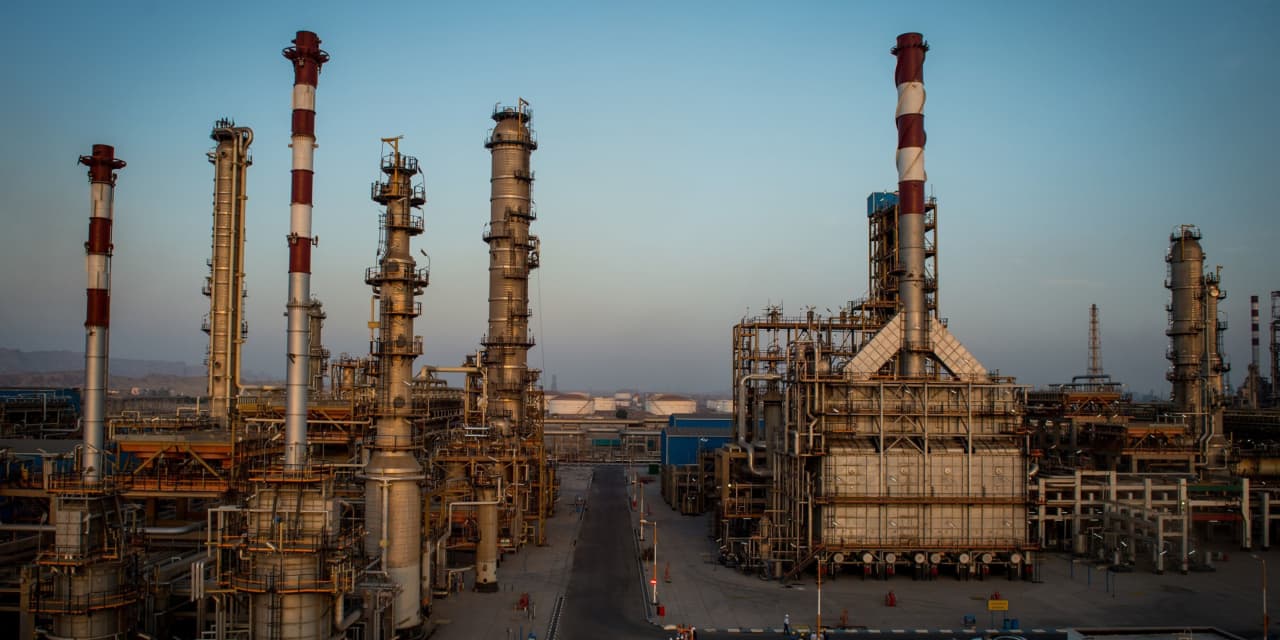
Visitors stand beneath cracking towers at Persian Gulf Star’s gas condensate refinery in Bandar Abbas, Iran, in 2019. Efforts to block Iranian energy exports could backfire by raising prices.
Ali Mohammadi/Bloomberg
About the author: Jeffrey J. Schott is a senior fellow at the Peterson Institute for International Economics and co-author of Economic Sanctions Reconsidered.
The horrific attacks by Hamas against Israel have prompted calls for retribution against the terrorists and those financing their actions. U.S. politicians have demanded more sanctions against Iran, the long-time funder of Hamas and Hezbollah, and some have proposed military attacks against Iran’s oil fields. The U.S. needs to sanction Iran, but “shoot first, aim later” measures are likely to backfire.
The objective is to defund Iran, starving it of oil revenues that could be used to fund terrorist organizations. But blocking Iran’s oil exports is not the solution. The potential cost to Western consumers could be large, fueling a political backlash against the sanctions policy.
Over the past year, the Brent oil price has roughly averaged about $80 per barrel. Brent oil prices spiked to $88 a barrel after the attacks on Israel. This week trading started around $90 a barrel. Prices could stay elevated if sanctions impede Iranian oil exports. Goldman Sachs estimates that, under its baseline projections, a net one million barrels a day drop in world oil supplies would raise oil prices by $10 a barrel.
Iran has exported about 1.4 million barrels of oil per day in 2023 according to firms tracking tanker shipments, a large share of which goes to China. Iranian oil exports would be around $41 billion if they sold at Brent prices, though they likely sell at a discount. Removing some or all Iranian crude from world markets, without offsetting Saudi supplies, would boost Brent oil prices sharply, to the benefit of Russian, Iranian, and Saudi producers and to the detriment of U.S. consumers.
More important than the level of exports are the revenues Iran generates from oil sales. Iran pays substantial sums to support terrorism and destabilize Middle Eastern countries. According to a 2018 study by the Foundation for Defense of Democracies, Iran spent about $16 billion per year, mostly to support President Bashar al-Assad’s regime in Syria. Only about $1 billion per year went to Hezbollah, Hamas, and the Palestinian Islamic Jihad in Gaza. Reducing Iran’s oil revenues would complicate Iran’s ability to fund its Mideast adventurism, but the impact would be far greater in Syria and Yemen than in Lebanon and Gaza.
The best way to squeeze Iran’s finances is by increasing oil supplies on world markets, reducing consumption, and thus putting downward pressure on oil prices. That successful recipe a decade ago contributed to plummeting oil prices and significant, but only temporary, constraints on Iran’s nuclear ambitions and terrorist financing. Rising oil prices, especially since the Russian invasion of Ukraine, have provided an economic windfall for the Iranian regime that needs to be slashed.
To be effective, sanctions should hurt the target country, deter others from coming to Iran’s aid, and limit to the extent possible damage to the U.S. economy and that of our allies.
U.S. Treasury officials recognize these criteria, derived from lessons learned from past sanctions experience, are essential to get the most out of deploying economic sanctions. To that end, they have quickly frozen $6 billion in Iranian funds held in restricted accounts in Qatar that would have been available for Iranian purchases of food and medicines as part of an agreement to free Americans held in Iran. They also continue to add to the list of individuals, entities, and shipping vessels barred from Western markets because of their complicity with Iran’s terrorist activities.
U.S. officials also need to warn Iran’s economic benefactors that Iranian adventurism in the Middle East risks destabilizing vital energy markets on which they depend. Such calls will fall on deaf ears in Moscow given its need for Iranian military equipment for its war in Ukraine. Beijing might consider them, however.
China currently takes the predominant share of Iran’s oil exports. It could easily increase its imports from Saudi Arabia and other Gulf suppliers to substitute for Iranian crude. China probably already demands price discounts for its purchases from Iran. At the very least, it should now insist that the price of imported Iranian crude not exceed $60 a barrel. Assuming a discount of $20 a barrel over the $80 a barrel average Brent price for most of 2023, such policies alone would reduce Iranian oil export revenues by almost $9 billion, equivalent to more than half of what Iran spends on supporting terrorism in Syria, Lebanon, and Gaza. Chinese officials are unlikely to sign up to an explicit oil price cap like that applied by the G-7 to Russia’s oil exports, but they could achieve the same result in pursuit of their own national interests by deeply discounting Iranian crude.
As a major energy importer, China needs stable political conditions in the Middle East. Containing Iran’s terrorist ventures by squeezing oil revenues is an important goal for which the U.S. and China should find common cause.
Guest commentaries like this one are written by authors outside the Barron’s and MarketWatch newsroom. They reflect the perspective and opinions of the authors. Submit commentary proposals and other feedback to [email protected].
Read the full article here