



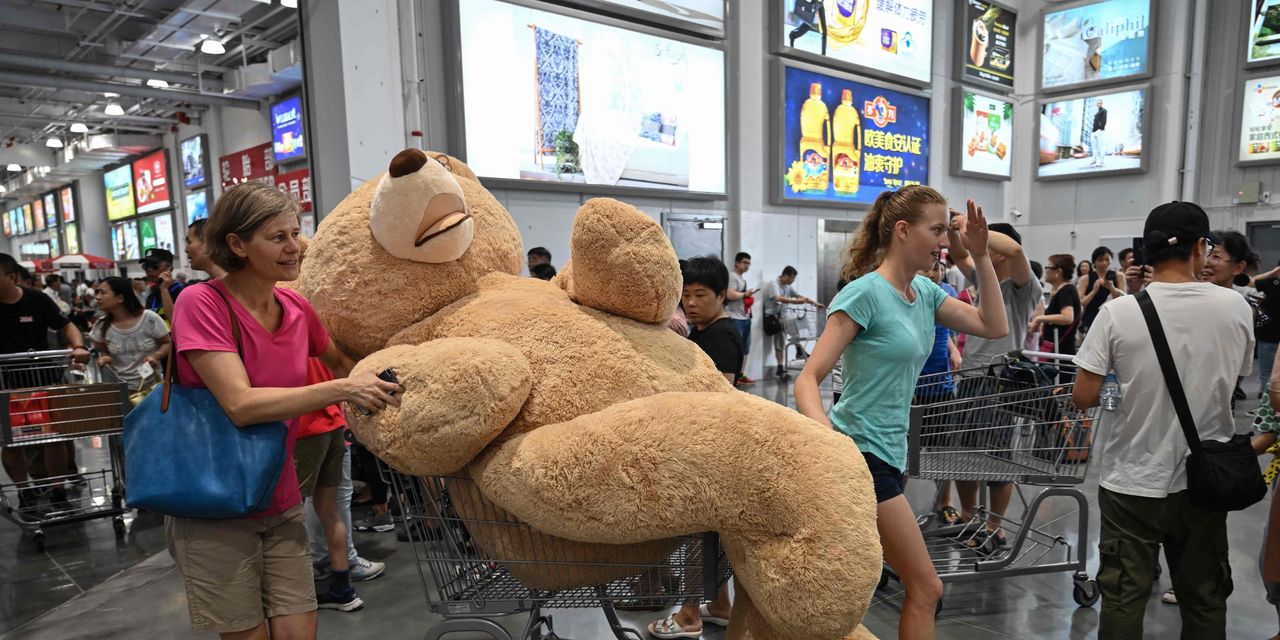
Supermarket chains in China are having a rough go of it.
There was a sign of relief last year when China dropped its draconian COVID movement restrictions, with observers expecting a surge in shoppers flocking to big-box stores after being confined to their homes for months on end.
It didn’t happen.
The reasons range from evolving consumer preferences to e-commerce to infighting among partnered firms.
So far this year, retail sales for China’s supermarkets have fallen by 0.4% vs. comparable 2022 figures, despite a 6.8% rise overall for consumer goods during the same period, according to the National Bureau of Statistics.
The consumer sector has been buoyed particularly by services over the past few months, with solid growth in hospitality and catering, IT and software, transport, warehousing, postal services, and financial services.
Eight of China’s 13 publicly traded supermarket operators either lost money or saw their revenues decline in the first half of this year, according to company financial filings.
Growth is either negative or in the single digits for department stores and chain convenience stores, as well.
Meanwhile, online retail sales are up 11.6% in the first nine months this year, according to data from the statistics bureau.
Carrefour China had 260 stores in 2017, making it the then-largest supermarket chain in the country. That number had shrunk to 150 by the end of 2022.
“I’ve witnessed the decline of Carrefour in my hometown,” said 28-year-old Yang Lihua, who lives and works in the western metropolis of Chengdu. “The store now seems half empty of goods and mostly empty of customers.”
Carrefour, like the other Chinese supermarket operators to which MarketWatch reached, declined to provide comment.
Carrefour China’s decline from 2017 onward began with its being unprepared for the rapid rise of e-commerce giants Alibaba Group Holding
BABA,
9988,
and JD.com
JD,
9618,
which leaped into the space under their own labels and with significant investments in existing sellers.
Things only worsened.
The pandemic hit, striking bricks-and-mortar Carrefour particularly hard.
The company is now in a legal battle with Chinese conglomerate Suning, which had been operating stores under the Carrefour banner after buying an 80% stake in the French retailer’s China business for $656 million in 2019.
A Carrefour store in Beijing as seen in 2011.
frederic j. brown/Agence France-Presse/Getty Images
Things went awry when Carrefour exercised a put option requiring Suning to buy the remaining 20% — which it has failed to do, according to Hong Kong court documents.
Rivals haven’t fared much better.
The country’s largest operator of supermarkets, Sun Art Retail
SURRY,
6808,
which runs the popular RT-Mart chain, bled more than $100 million in cash in 2022, despite Alibaba’s upping its stake to 72% from 36%. It has since slashed expenses and is back in the black, company filings show.
Better Life
1805,
— which lost $61 million in the first half of this year — has faced worker protests around the country after it allegedly failed to compensate employees when it closed a number of stores.
Losses for Lianhua Supermarket Holdings
980,
this year have only exacerbated its roughly 80% stock-price decline since 2021.
Walmart
WMT,
which has been in China since 1996, has had more mixed results.
Over the last few years, it began selling off most of its overseas operations, including those in Japan, the U.K. and Brazil. But it kept its retail presence in China.
From the archives (December 2021): Walmart, Intel face backlash in China for avoiding imports from Xinjiang under new U.S. law
After multiple consecutive years of closing more stores than it was opening in China, Walmart, when the pandemic struck, recognized something: Its smattering of Sam’s Clubs around the country was one of the few bricks-and-mortar success stories of the COVID era, allowing families to stock up on long-lasting supplies.
Sam’s Club has become as crucial to the company’s China prospects as Walmart stores themselves. Sam’s Club is set to have 48 locations across China by the end of the year and had 4 million members by December 2022, according to company documents.
Sam’s Club rival Costco
COST,
hopes to open its sixth store in China by year’s end.
But in MarketWatch conversations with nearly a dozen Chinese consumers, many cited specialization among smaller stores as their reason for eschewing traditional supermarkets that are now struggling.
“I order meals from restaurants in my district and groceries from smaller shops nearby,” said Chen Gang, who works from home for a tech startup in Beijing. Delivery is almost always free, he said, and an order’s arrival time can be as fast as 15 minutes.
Tanner Brown covers China for MarketWatch and Barron’s.
More dispatches from Tanner Brown:
U.S. businesses operating in China are confused and worried. Here’s why.
China’s economy is suffering, and consumers won’t open their wallets — except to see movies
China’s youth job market is a nightmare. It’s changing the face of the country.
China’s property woes offer a window into the demise of the country’s boom times
Read the full article here