



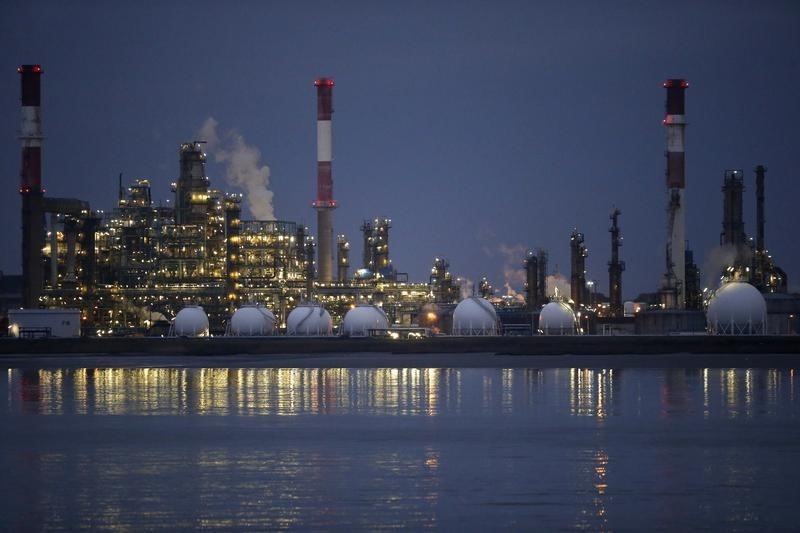
© Reuters. FILE PHOTO: A man is seen at an exit of the refinery plants of Chambroad Petrochemicals in Binzhou, Shandong province, China October 24, 2019. REUTERS/Stringer/File Photo
By Chen Aizhu
SINGAPORE (Reuters) – China has set a minimum size for new oil refineries and will ban small crude processors that claim to be chemicals or bitumen producers under a plan to limit total capacity at 1 billion metric tons, or 20 million barrels per day, by 2025.
Following are key details on China’s steps, outlined this week, to rein in a refining industry that recently surpassed the United States to become the world’s largest.
WHAT IS CHINA TRYING TO ACHIEVE?
The overall capacity cap, first unveiled in October 2021 as part of a plan to reach peak carbon emissions by 2030, is aimed at curbing excessive domestic refinery production and supply overhang to reduce greenhouse gas emissions.
China has long sought – and sometimes struggled – to remove excess capacity in highly polluting heavy industrial sectors such as steel and cement.
The think tank Sinocarbon says the refining and petrochemical sectors accounted for 8% of emissions in 2020.
The cap will also help curb China’s already high reliance on imported , which stood at 76% last year.
HOW HAS CHINA’S REFINERY SECTOR GROWN?
Refining capacity in China increased last year to 920 million metric tons per year, or 18.4 million bpd.
The industry’s recent growth has been driven since 2019 by the creation of three large independent refiners – Zhejiang Petrochemical, Hengli Petrochemical and Shenghong Petrochemical – adding a combined 1.52 million bpd capacity that is highly integrated with petrochemicals making.
Together with dominant state refiner Sinopec (OTC:) and its rival PetroChina, as well as an army of about 60 smaller independent processors known as “teapots”, the refining sector has ballooned into the world’s largest, surpassing the United States last year.
That growth has resulted in a low refinery utilization rate of 73% in 2022, based on official output data, compared with more than 91% in the U.S., which means China has surplus capacity to allow for large volumes of refined fuel exports.
WHAT IS THE LIKELY IMPACT OF THE MEASURES?
The measures could force more closures of small, inefficient plants, which have already taken place in teapot hub Shandong province, where some 400,000-bpd worth of capacity was mothballed in 2020 and 2021 to make way for the new Yulong Petrochemical plant of a similar size.
Others players are expected to look abroad for growth. Polyester fiber maker Tongku Group and Rongsheng Petrochemical are both exploring building new refineries in Southeast Asia.
Many teapots, meanwhile, have over the years quietly expanded processing capacity, invested in oil storage or moved up the product value chain to make energy transition chemicals.
WILL CHINA ACHIEVE ITS GOALS?
Apart from increasing scrutiny in approving new plants, the government can wield the powerful tool of crude oil import quotas, to which all independent refiners are subjected.
In recent years, the cap has stood at an annual 243 million tons, or 4.86 million bpd and actual grants have run below that.
Thanks to rigid quota management and crackdowns on illegal quota trading, China has already managed to limit refinery operations to some extent.
Meanwhile, the government also maintains tight control over refined fuel exports, allowing only state refiners and one independent major refiner, Zhejiang Petrochemical Corp, the right to export.
WHICH ARE CHINA’S BIGGEST REFINERS?
China has about 34 refineries of 200,000 bpd or more, with combined processing capacity of 480 million tons, or 9.6 million bpd, according to Sinopec.
Most of these plants are run by Sinopec, PetroChina and China National Offshore Oil Company. Together, the three state giants operate nearly 12 million bpd of processing capacity.
HOW MUCH NEW CAPACITY IS IN THE PIPELINE?
Four new refineries with combined capacity of 1.2 million bpd are planned, including the 400,000 bpd Yulong Petrochemical complex in Shandong, the 300,000-bpd Huajin Aramco (TADAWUL:) Petrochemical Company in Liaoning province in the northeast, and the 320,000-bpd Sinopec Gulei refinery, as well as the 300,000-bpd expansion at Sinopec Zhenhai.
(ton=7.3 barrels for crude oil conversion)
Read the full article here