



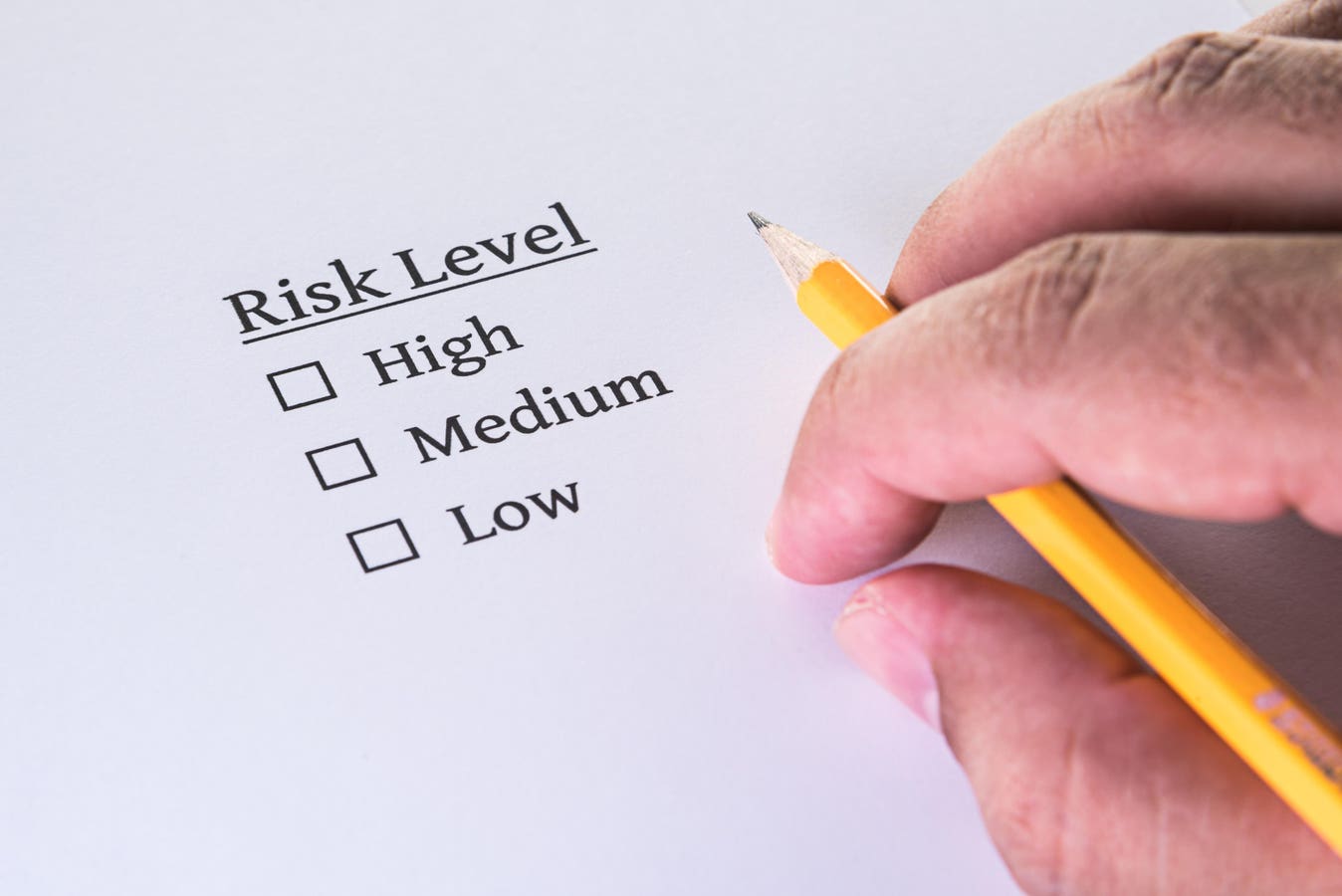
Participation trophies don’t put food on the table when you’re retired. Rather than relying on such feel-good gimmicks, high earners are better served by mathematical stoicism in their risk tolerance and capacity decisions.
Sure, that might sound like a mouthful, but it just means taking a disciplined approach to saving and investing both before and during your retirement.
Why risk tolerance questionnaires fail
Here’s the problem: currents within the investment community have led people down a primrose path of unintentional deception. Are you an unsuspecting victim of this? If you’ve ever taken a risk tolerance test, you may be.
“Trying to determine willingness to bear risk is problematic,” says Robert R. Johnson, Professor, Heider College of Business at Creighton University in Charlottesville, Virginia. “It is most often captured by posing the question, ‘Would you be able to handle a downturn of 20%, 30%, or 40%, etc. in your portfolio’s value?’ What people say they would hypothetically be able to handle and what they are really able to handle are often different concepts. It’s akin to practicing golf on the driving range and hitting shots under tournament conditions. You simply can’t replicate the conditions in the hypothetical case or on the driving range. And, we saw that in spades during the financial crisis of 2008 when the S&P 500 fell 37% in 2008 alone. Many investors ran for the exits, liquidating at the lows, only to re-enter the markets when they had recovered. The same phenomenon happened in March of 2020 during the coronavirus pandemic.”
Two examples expose when risk tolerance backfires
To grasp the potential danger, imagine these two extremes. First, Dr. Smith, a successful practitioner, dutifully maxes out his 401(k) contributions every year but leaves the driving to the plan pros so he can focus fully on his patients’ needs. He follows the advice of the financial experts governing his retirement plan. He even completed a risk tolerance questionnaire. Given his wealth and professional competence, the risk quiz told him to invest “aggressively.”
But other factors in his life tell a different story. At age 65, he plans to retire within two years. But he’s not thinking about his annual retirement expenses, though. Still working, his mindset remains in the “saving” mode. He’s not mentally preparing for the shift to “spending” mode once retirement hits.
During his saving cycle, he can afford to invest “aggressively” because time and savings can replenish any losses. The spending part of life represents a wholly different situation. Short-term losses can have a lasting impact. It doesn’t matter if he can emotionally absorb the impact of investment losses if his bank account can’t.
The most significant risk near or new retirees face is “sequence of returns” risk. It’s when the market takes an abrupt downturn as you are on the cusp of retirement. This has nothing to do with your emotional tolerance. It’s about how much you have when retirement begins.
Now imagine a 20-year-old who scores as “risk-averse” on a risk tolerance questionnaire. Should he invest conservatively, despite a nearly half-century time horizon? Of course not.
The Math That Matters: Defining Risk Capacity
For decades, financial advisers have referred to the term “risk tolerance” to help guide their clients’ investments. Assessments following this process aim to gauge investors’ emotions in response to the ups and downs of markets. Over time, however, it’s become apparent that people can’t accurately predict their investing emotions. They say they can stomach a sudden 20% drop in the markets, but when it happens, they call their broker and yell, “Sell! Sell! Sell!”
A growing number of advisers are turning toward another risk assessment tool called “risk capacity.” Rather than emotions, risk capacity relies on math. It measures how much you actually need to meet your financial goals. Say you need $100,000 for a potential down payment on a house in six months. If you have that money now, you have zero risk capacity to lose it, so you invest in the safest instrument. But if you still need to earn $5,000 over the next six months to attain your goal, you’ll have to find an investment that gives you a reasonable chance to achieve that.
Notice the word “chance” there. That means there’s a “risk.” It’s a risk you’re willing to take. It’s a risk you must take if you want to make that down payment in six months. The key is to start with your numbers, not your feelings.
Given this, you can see why risk tolerance fails precisely at the most stressful time—when the stakes are highest.
“Tolerance is best understood as how much pain you can stomach,” says Eric Croak, president at Croak Capital in Toledo, Ohio. “Capacity is best understood as how much risk your situation can handle. They measure two entirely different things: one measures temperament while the other measures balance sheet reality.”
Unfortunately, tolerance is harder to quantify. Because of this, it’s easier for people to “understand” it. There’s no right answer, so whatever you believe is “right.” That can be very comforting to you. But comfort does not drive investment returns.
Risk Capacity Factors
Facts, in contrast, can bore you. They can also befuddle you. But when applied correctly, they can lead to better results. They tell you your true risk ceiling.
“Risk tolerance is qualitative and feelings-based, while risk capacity is quantitative and fact-based,” says Pat Zingarella, founder/CEO at Invest Clearly in Clinton, Connecticut. “Think of risk tolerance as saying, ‘I understand and feel comfortable with this level of risk,’ and risk capacity is your bank account saying, ‘Well, you really shouldn’t.’”
Use income stability, net worth outside the 401(k), and years to retirement as your guardrails. Next, apply them to your plan menu. Not that you should ignore your emotions. In fact, it’s better to recognize them. This way, you can control them when necessary.
“We love it when participants in 401(k) plans are concerned about risk tolerance and risk capacity,” says Terry Morgan, president at OK401k in Oklahoma City. “But we feel the single best improvement we can do for an individual is to save more. Anyway, tolerance is about how much market turbulence someone feels comfortable with — it’s emotional. Risk capacity is about how much risk someone can actually afford to take without jeopardizing their financial goals. We use tools to bridge those two worlds, so participants see both the math and the emotion side of risk.”
Perhaps this can be your blueprint. Lead with your measurable capacity for risk. Then, assess your tolerance for risk. Understand your emotions, but don’t make any life-altering decisions because of them.
Starting retirement is like starting a new business. And like successful entrepreneurs, it serves you well to take a calculated—and controlled—risk, not let emotions intimidate you.
Read the full article here