Financial foolishness is everywhere and easy to spot, but one of my favorite pastimes is finding financial wisdom where you might not expect it, especially in the arts and music. In past posts, I’ve explored the profound financial insight of Bob Marley, Mumford and Sons, Jason Isbell, and the Avett Brothers. Today we examine the financial phraseology of one of the most respected rappers, J. Cole.
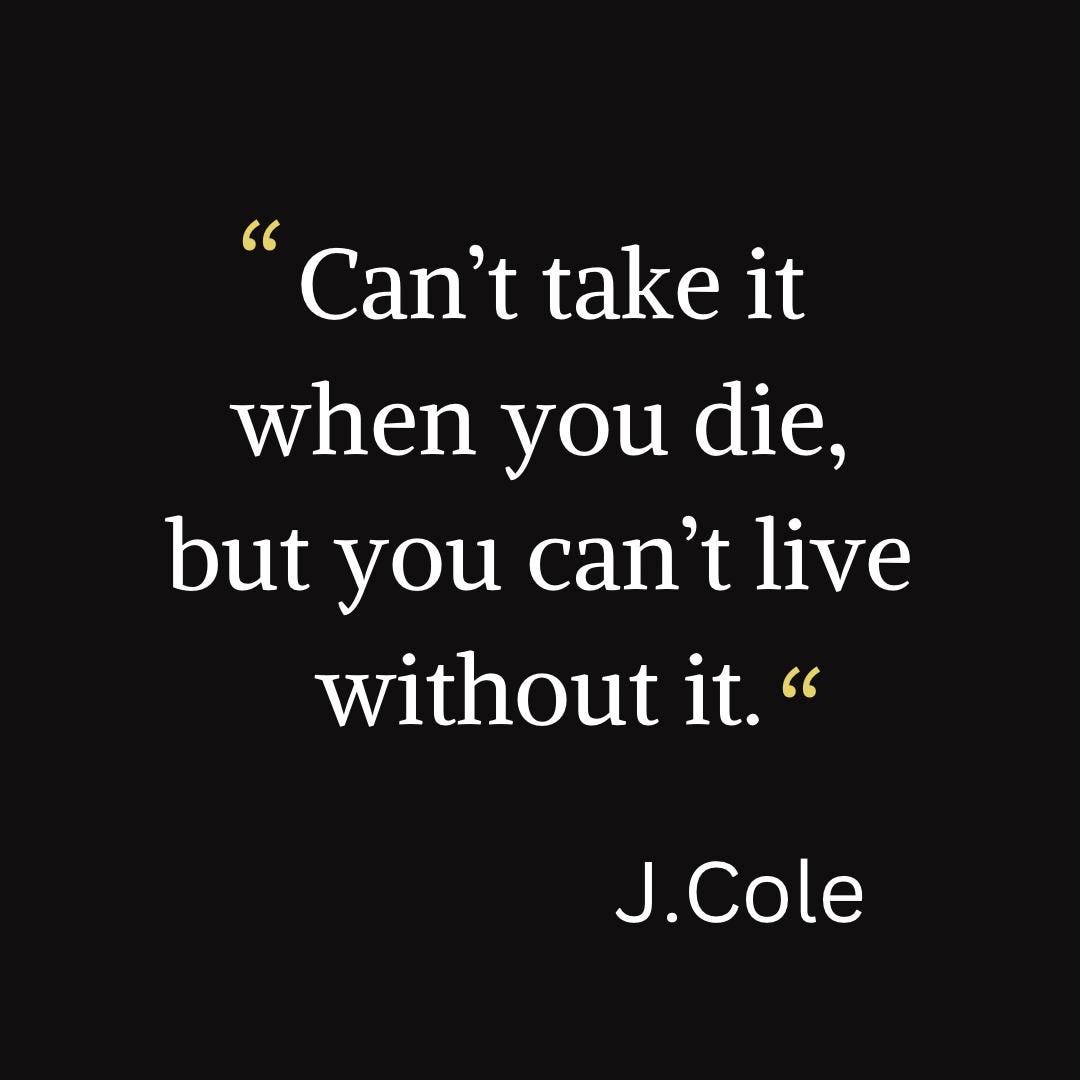
“Can’t take it when you die, but you can’t live without it,” is the central refrain squeezed in between the percussive “Count it up, count it up, count it up, count it” chorus throughout the song, ATM, on his hit album, KOD. (Uh, Mom, before you head on over to YouTube and play this song for Dad in the kitchen, let’s talk. 😊)
While Cole explores many different themes in the song, including the desperate drive to rise from rags to riches, the magnetism of wealth, and the trappings of excess, I find it’s this two-sided coin in the chorus that represents such a gem as described by Oliver Wendell Holmes as “the simplicity on the other side of complexity.”
Note that he starts with the end in mind, the unavoidable truth that you’ll never see on a financial industry billboard or commercial (and that is downright contrarian in the hip-hop canon), that you “can’t take it when you die.”
Hedge fund manager and author Bill Perkins, devoted an entire volume to this reality in his controversial book, Die With Zero, in which he insists that every dollar we leave behind (yes, including those designated for children and charities) represents potentially rich life experiences that could’ve been but never were. He further considers the time spent to produce and invest those unspent funds as time suboptimally employed, thereby compounding the “loss” incurred by dying while still sitting on a pile of cash.
It’s safe to say, however, that the pronouncement, ““Well, you can’t take it when you die!” , has preceded a lot of very poor financial decisions. So Cole doesn’t leave it there; he also addresses the apparent contradiction that, indeed, “you can’t live without it.”
Eschewing money as evil or unimportant may be a sure way to avoid keeping up with the Joneses, but it invites a host of its own problems. Even minimalism costs something. So, where does that leave us, but holding these two seemingly opposing truths in tension, unable to refute either?
I’d like to submit that the tightrope we walk between the two is that money is neither inherently good nor bad; it is simply a neutral tool to be used well or poorly. It is not an end in itself, but it can be an incredibly serviceable means.
Practically speaking, there are four ways that money can be helpfully employed. We can use it to:
· LIVE comfortably and confidently.
· PROTECT your family, property, and lifestyle.
· GROW your assets to recreate your income in the future.
· GIVE to the people and causes most important to you.
Those with a discerning eye will note that I have waded into some relativistic territory here. You may agree with me that money is a neutral tool to be used well or poorly, but our opinions would almost surely diverge on what precisely is a wise and unwise utilization of funds.
Sure, there are certain things we might agree on universally, but I’m also sure we could find someone in opposition to giving money to feed starving puppies and someone else to support using high-interest rate credit card debt to buy lotto tickets. But regardless of where we’d establish the boundaries of virtual certainty, there’s a ton of gray area in the middle, the rightness and wrongness of which can only be defined by you and yours. (That, by the way, is the real work of financial life planning.)
That’s also why I’ve not given the above list numbers, but bullets. Each individual and family must determine its life and financial priorities, and it’s highly likely they will shift over time. Today, it might be LPGG, but in five years, it could be GPGL.
Regardless, while it is our work to manage the tension between these two truths, J. Cole has provided us with the undeniable parameters, that when it comes to money, you “can’t take it when you die, and you can’t live without it.”
Read the full article here