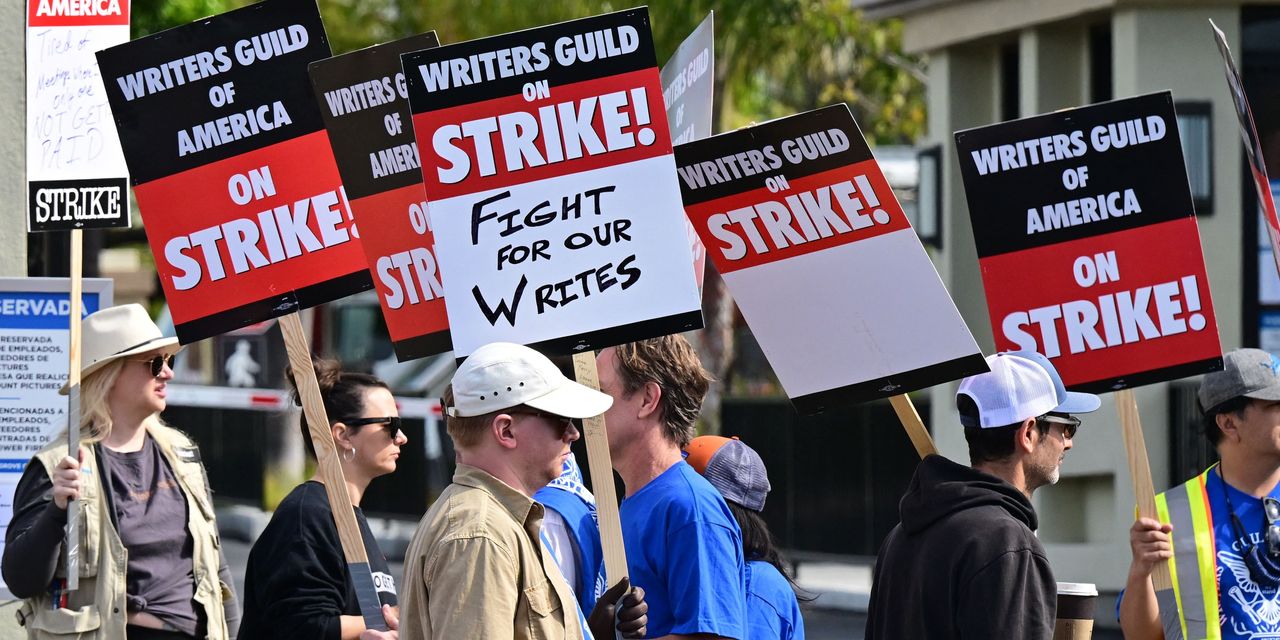
The Hollywood actors and writers strikes spotlight many of the difficulties that businesses and workers both face in the post-COVID economy and from the challenges of the growing gig economy and artificial intelligence.
To understand why, you have to go back before cable, big-screen TVs and the internet. Then, just about everyone was limited to what local theaters and the three major television networks offered. Larger cities also had one or few independent stations, whose prime-time fare was mostly reruns of network shows and old movies.
In this environment, the residual system emerged. Actors and writers were paid both for their initial work and again for reruns, mostly by affiliates and independent stations. While production studios and major networks hardly had monopolies, consumers’ limited choices brought in revenue that the owners of content could share with on- and off-screen talent.
In this system, working-class actors and writers — talent who are not the big stars or show creators — generally worked steadier, earned more and enjoyed a better employment environment..
More writers were present during actual filming, and participated in set and costume design, continuity and so forth. This permitted less-experienced writers to acquire skills to become showrunners, film editors, directors or primary creators for new movies and TV series.
Show stoppers
The industry’s upheaval began in the early 1980s. The proliferation of competing networks on cable opened wider employment opportunities, but the biggest change came with the fusion of big-screen digital TVs and streaming about a decade ago.
Falling prices for high-quality, big-screen TVs challenged movie theaters, and the number of tickets sold declined. Nowadays , releases with mega stars, high action, complex visual effects and a lot of noise — franchises like Indiana Jones and comic-book superheroes — still have theater screen appeal. Yet for ordinary drama and comedy, it takes a more compelling story to get Americans away from their couches into the theaters.
“Working-class actors and writers simply have a tougher time earning a living.”
There’s still a lot of revenue generated from content, of course, but people have more choices — both the number of outlets for new movies and TV shows and a catalogue of content going back to the earliest motion pictures.
As a result, the market is fragmented. Working-class actors and writers simply have a tougher time earning a living. Writers’ rooms are smaller, fewer work on set and streaming series have perhaps 10 episodes per season as compared to linear TV with 22. Working-class actors scramble more to piece together enough employment.
What about residuals — so crucial to actors’ and writers’ long-term income? The payouts are much smaller than they were when theaters and broadcast and cable TV dominated.
With more Americans opting out of cable and relying on streaming, the film and television industry’s problems have worsened. The big studios and other entrepreneurs have rushed into streaming, and the lake is overfished. Netflix
NFLX,
owing to its first-mover advantage, earns a profit, but Walt Disney
DIS,
Comcast
CMCSA,
and Paramount lost a combined $8.4 billion in 2022. Subscription fees are rising but the number of movies and shows produced must get smaller or less expensive to produce.
“The actors’ and writers’ strikes pit working-class talent against highly paid star actors and creators/writers.”
Ultimately, the actors’ and writers’ strikes pit working-class talent against highly paid star actors and creators/writers. These job actions put producers in the tough position of dividing the loss among those groups while seeking to restore their bottom lines.
That is, unless some innovation comes along that dramatically raises productivity. Enter stage right: artificial intelligence.
Much of what writers do is highly formulaic and a good deal of that will soon be doable in first draft by AI programs. Where four or eight writers worked on a movie or show, perhaps just one or two will suffice.
Like actors worried their identities will be appropriated by computer recreations, writers need limits on the use of characters and the fictional worlds they create. The same problem faces fiction writers with print and online publishing.
As Netflix and Amazon.com AMZN demonstrated by becoming producers of original content and streaming services, the industry’s entry barriers are not high. If the Screen Actors Guild and Writers Guild of America win overly strict limits on the use of AI by major studios and incumbent streaming services, new independent producers and services will emerge that employ actors and writers and offer more flexibility. Actors and writers willing to permit more liberal use of their likenesses and creative work would thrive.
Peter Morici is an economist and emeritus business professor at the University of Maryland, and a national columnist.
More: If Sarah Silverman wins her lawsuit, OpenAI, Meta Platforms and other AI developers could face waves of litigation
Also read: As Hollywood strikes continue, unions call out excessive CEO pay: ‘We need to look at what they’re doing with executive compensation’
Read the full article here