The President fired the nation’s top labor statistician because the jobs numbers embarrassed him. On August 1, after BLS reported weak job creation and sizable downward revisions, the president dismissed Commissioner Erika McEntarfer, accusing her – without evidence – of faking data. Statisticians across the political spectrum condemned the move as an attack on the integrity of federal statistics.
Historian E.J. Hobsbawm famously observed counting workers is inherently political. Labor statistics track workplace injuries, unemployment, productivity bottlenecks, and more. Governments use them to solve problems. Employers and unions use them to negotiate fairly. Society uses labor statistics to see workers.
By not filling vacancies, the National Labor Relations Board has been neutralized—any union-busting will go unchallenged. Bloomberg reports that the president also ordered federal agencies to cancel collective-bargaining rights. I recently met a longtime employee of the Veterans Administration who wondered if she would be fired before collecting her pension. This is not just a policy fight—it is a struggle over who gets to define the numbers, and whether workers get a voice and protection. The law and enforcement effectively bars Americans who want unions to get them.
If Every Worker Could Vote For There Would 60 Million Union Members
The law won’t let them have one. Public support for unions is back to late-1950s levels: 68% approval this Labor Day—five straight years hovering near 70%. According to the Economic Policy Institute; if every worker had the chance to vote in a union election today, union membership would rise by 60 million. That would push union density from 9.9% to nearly 46% of the U.S. workforce
Why do workers want unions—and why do employers resist? Economists have long recognized the union premium. In 2024, the typical union-represented worker earned $1,320 a week versus $1,138 for comparable nonunion workers—a 16% edge. Union workers are also much more likely to have pensions and health insurance.
New data from the prestigious National Bureau of Economic Research (NBER) underscores these findings. In “What Do (Thousands of) Unions Do?” researchers show that unions raise wages on average. After nationwide repression of unions, wages fell more in markets where unions had previously delivered larger gains. When unions are weakened, pay falls – especially where they were once most effective.
Economic Effects Of Unions: Making Economies Better
In the U.S. and in peer nations, the International Monetary Fund finds that when union density and bargaining power fall, the top 10% or 1% of earners grow richer faster. Weaker unions mean workers have less influence over tax policy, leading to elite domination and faster profit growth in low-union companies. It is no surprise that firms and elites fight unions. But without countervailing worker power, the economy can be damaged by unchecked corporate control and government capture.
Economic Effects Of Unions: Making Companies Better
And unions make companies better. They raise productivity. Because labor markets are not perfectly competitive, employers often exercise monopsony power. Unions narrow that gap, forcing management to improve practices. A unionized workforce means workers stay longer on the job, stabilizing employment and building training ladders that boost productivity over time – even if this challenges short-term profits. Unions further increase productivity by reducing turnover, promoting professional training, and bargaining over safety standards.
By compressing arbitrary pay gaps, they force firms to compete through innovation rather than exploitation. Union enhance workplace experimentation because with union protection they can take risks. Where teamwork, problem-solving groups, broader job design, and gain-sharing are used as a system, productivity jumps. Landmark steel-line studies and workplace panel data show large gains when these practices are adopted—settings where unions often help codify participation and credible commitments.
Weakening unions doesn’t just lower wages; it tilts the political system toward capital, short-termism, and low productivity growth.
Rising Union Power
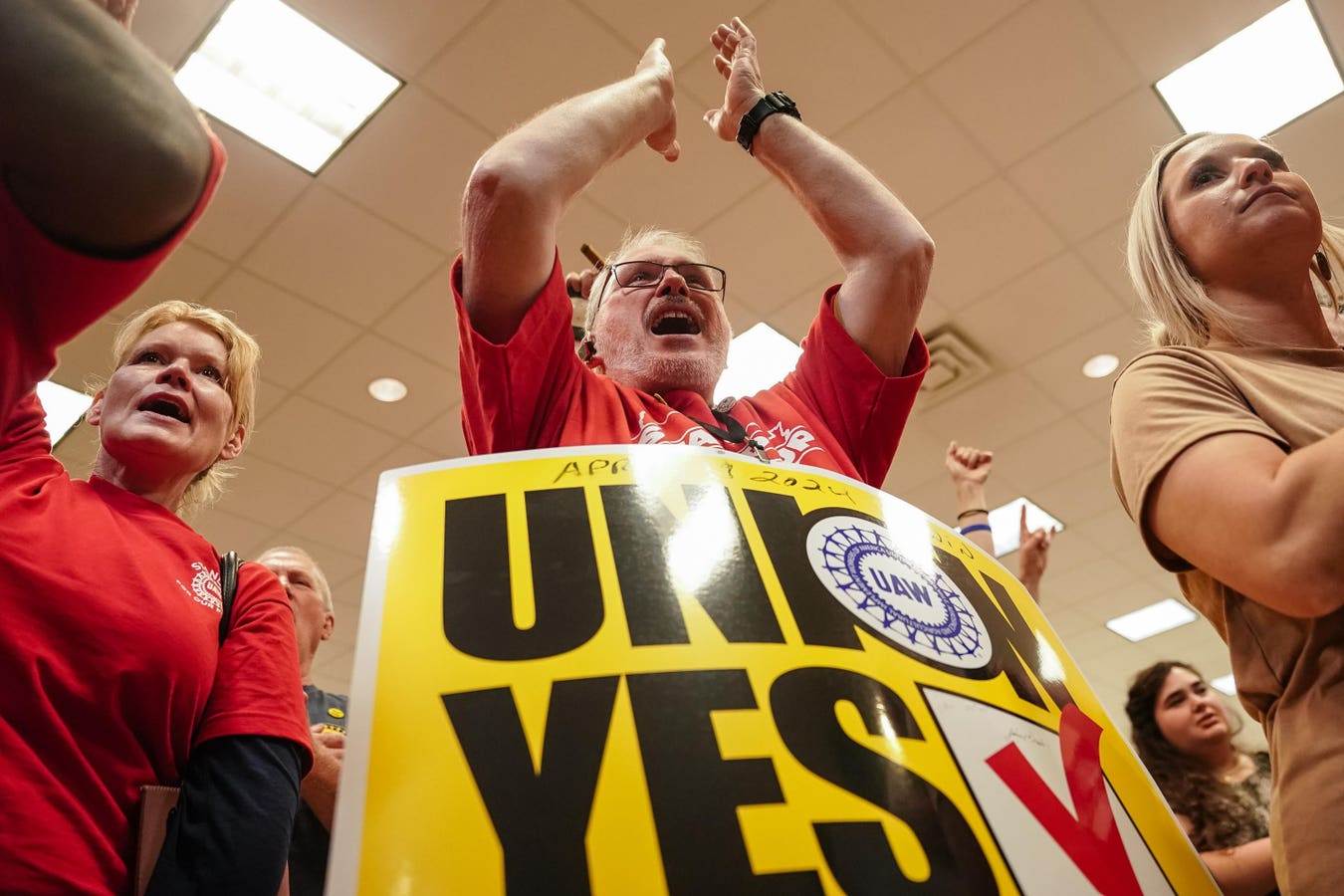
There are signs of renewed bargaining strength. Volkswagen workers in Chattanooga won union recognition in April 2024, cracking the South’s wall of opposition and proving that high-skill manufacturing need not be low-voice.
After 170 rolling strikes, more than 10,000+ Southern California hotel workers ratified contracts at 34 properties with record raises—an object lesson in how collective action converts inflation anxiety into take-home pay. And Microsoft embraced neutrality after heavy union pressure.
Since the NLRB will be weak for quite a while but a new study by The Center for Work And Democracy at Arizona State University identifies workers can influence a high road economy that go beyond traditional collective bargaining. .
Their reports argue that industry-level campaigns can establish baseline standards, such as the Fight for $15 movement, which set wage benchmarks across fast-food chains by 2021. Teachers’ unions, like the Chicago Teachers Union, have broadened bargaining to include class size and school nurses.
Healthcare unions have pushed for government action to cancel medical debt. Grassroots organizing led by front-line workers—minimizing the need for hierarchical leadership—has also proved powerful. For example, the 2018 Red for Ed teachers’ strikes in West Virginia and Arizona leveraged Facebook organizing and drew strong public support.
Legal and political constraints—especially within the NLRB process—limit broad-based organizing and deter unions from innovating at scale. Yet the demand for worker power to counter corporate dominance will not disappear. We should expect more experimentation in how organized labor grows and with the labor movement economic strength and equity.
Read the full article here