

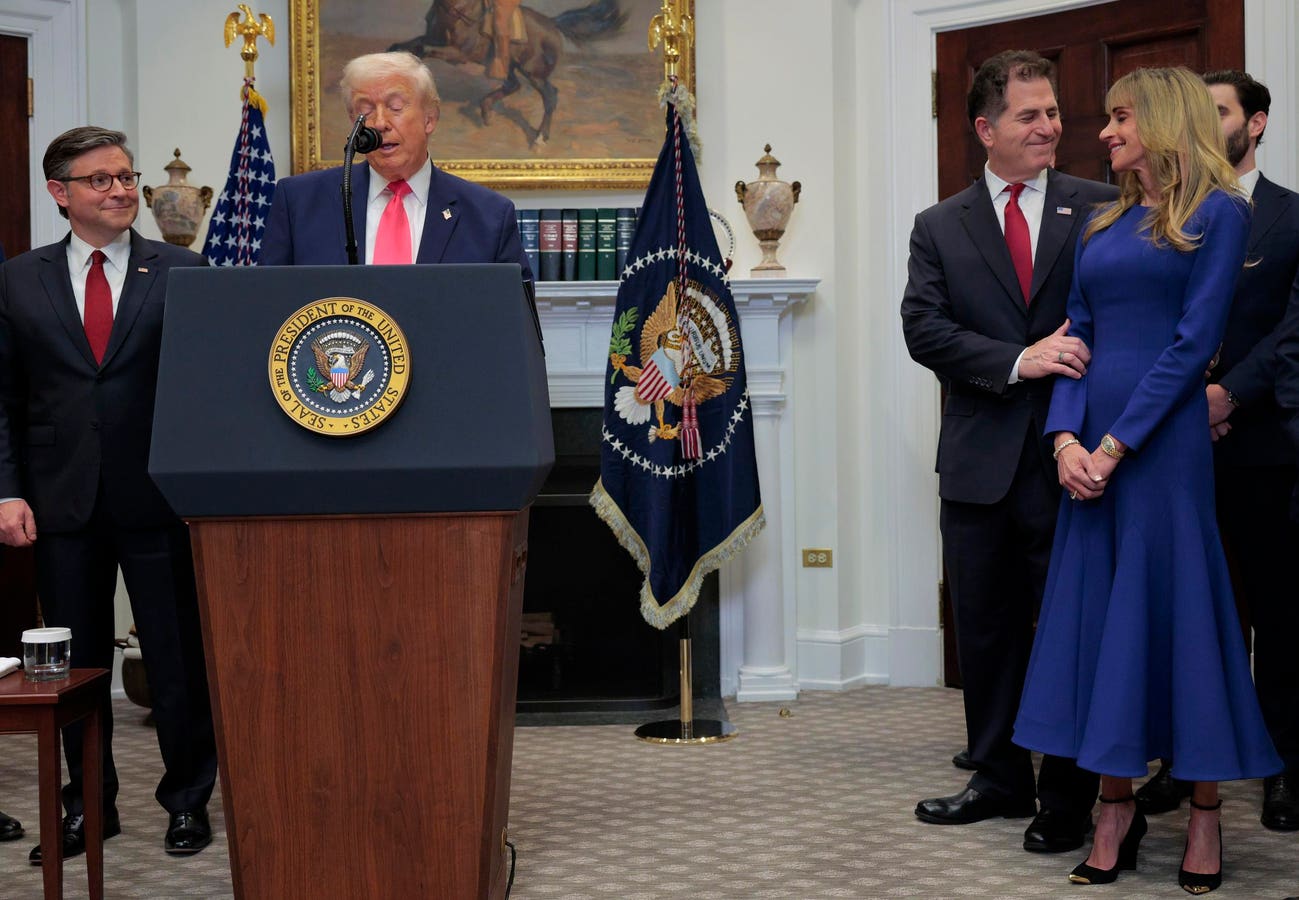
Michael and Susan Dell have pledged $6.25 billion to expand Trump’s child wealth accounts, but design flaws mean the biggest benefits will still go to higher-income families, not those who need them most. Their money will add $250 to the new federal “Trump accounts” for 25 million children younger than 10, supplementing the government’s $1,000 deposit for every baby born from 2025 through 2028.
The Dells deserve praise. They chose children, insisted on universal eligibility within an age group and framed their effort as a pilot that should be evaluated and improved.
But the mechanism they’re relying on — the Trump account structure — bears a familiar hallmark of U.S. tax policy: a benefit that sounds progressive but is built on a framework that ultimately favors those who are already wealthy.
The issue is not the Dells’ motives, but whether charitable vehicles like this can deliver meaningful opportunity.
Trump Accounts Draw On Long-Standing Policy Concepts
The Trump accounts were established under the One Big Beautiful Bill Act as a new type of custodial IRA for children, sometimes called 530A accounts. Once a child receives a Social Security number, the Treasury deposits $1,000 for every U.S. citizen born Jan. 1, 2025, through Dec. 31, 2028.
The Dells’ donation expands the program by providing $250 to children younger than 10 who do not qualify for the federal $1,000 because they were born before 2025. The Washington Post reported that their gift is intended to reach 25 million children.
The logic behind both the federal seed deposit and the Dell expansion follows classic baby bond thinking: Give every child a small asset at birth, or early in life, to help pay for education, buy a first home or start a business. The idea has deep progressive roots in the baby bonds framework developed by William Darity Jr. and Darrick Hamilton, which proposes an economic birthright to capital that provides larger deposits for poorer children to directly address the racial wealth gap.
Trump accounts borrow the branding and some of the rhetoric of baby bonds. They do not adopt the most important design features.
Trump Accounts Leave Middle-Income Families Out
Ashlea Ebeling and her colleagues at The Wall Street Journal have provided the most thorough technical explanation of these accounts to date. In short,
Under current law, a Trump account is a custodial IRA for a child, with special rules in place until the year they turn 18. The Treasury’s $1,000 seed deposit grows tax deferred, a feature that mainly benefits families in higher tax brackets and provides little value to low-income households that pay minimal federal income taxes. Withdrawals are taxed as ordinary income, which is progressive, but the penalty structure is regressive. Unless the funds are used for approved purposes, such as higher education or a first-home purchase, using the money for everyday needs like a car or overdue rent triggers additional penalties.
Another source of regressivity is the contribution rule. Parents, relatives and friends can add up to $5,000 a year in after-tax dollars, indexed to inflation. Families at the top are far more likely to have relatives and friends who can make substantial contributions.
Employers can contribute up to $2,500 a year per child, also indexed. But half of workers do not have employers who contribute to their retirement funds, so employer contributions are not likely to be widespread. Charities, such as personal foundations of wealthy families, can contribute, but only on equal terms for a defined class of children, such as all children born in a city in one year. This has uncertain equity effects.
It is widely accepted that the funds must be invested in low-cost mutual funds or ETFs, mostly U.S. equities, with an expense ratio capped at 0.10 percent. The regressivity comes from how typical household behavior interacts with the tax code. The seed money, along with employer and charitable contributions, is treated as earnings for tax purposes. As a result, distributions become mechanically complex. Every withdrawal is partly taxable, and some uses trigger a 10 percent penalty before age 59½.
Financial planners quoted in the same Wall Street Journal piece are blunt. For most families, a 529 plan, a Roth IRA for working teens or even a taxable brokerage account is more flexible and tax efficient than putting additional family money into Trump accounts. Only wealthy families who have already maxed out other tax-favored vehicles may see these accounts as a useful extra shelter.
Even economists generally favorable to tax-based saving incentives point out that Trump accounts are unusually complicated. At AEI, Alan D. Viard warns that the biggest benefits accrue to those who can contribute most. In other words, the free $1,000, or Dell’s $250, is simple and progressive. The rest of the structure is not.
Allowance Structure Favors Those With Greater Means to Contribute
The crucial question is not whether every child deserves a starter asset — they do. The real question is which families can realistically add another $5,000 a year per child to a specialized account with complex tax rules.
This is where the distribution of wealth matters in determining who benefits from the Trump accounts. There is no official estimate of how many children younger than 10 live in, for example, millionaire households, but one point is clear: Only a minority of children will have relatives or employers who can consistently contribute $5,000 a year to a Trump account beyond the initial seed money. For most children, the account will remain a $1,000 to $1,250 starting balance plus any market returns — not nothing, but far from transformative.
By contrast, a child whose relatives and friends can contribute the full $5,000 a year for 18 years, and whose employers also contribute, is a clear beneficiary. For that small group, the Trump account is another tax-advantaged asset wrapper layered on top of 529 plans, retirement accounts, home equity, capital gains and business ownership.
That is the classic pattern of American tax policy: The structure says it is for everyone, but the practical benefit scales almost linearly with how wealthy your family and their friends are.
Trump Accounts Are Not Baby Bonds
Economists Darrick Hamilton and William Darity’s baby bond proposal takes the opposite tack: Make the accounts larger for children from poorer families, not smaller. Their original design envisions a public trust account for every newborn, with balances between about $500 and $50,000, inversely related to family wealth.
The goal is explicitly to confront the racial wealth gap produced by centuries of unequal access to property, credit and protected assets. As Hamilton and co-authors explain, it is not effort or education that primarily separates Black and white families, but the “unearned birthright” of inheritance and family transfers.
Trump accounts, even with Dell’s expansion, do not target children with the least wealth behind them. They do not vary deposits by family wealth. The tax rules surrounding additional contributions are structured to benefit families best positioned to use them.
If you strip away the branding, Trump accounts look less like baby bonds and more like another entry in the long history of upside-down tax expenditures, where the largest dollar benefits flow to those in the highest brackets.
What Effective Help For Children Could Look Like
For many Americans of my generation, the closest equivalent to baby bonds in the 1970s was public policy itself. In my case, that meant essentially free tuition at the University of California, Berkeley, and Medicaid coverage that paid for the asthma care my family could not have afforded alone. Those two pillars — education and health — served as my starter assets, giving me hope and aspiration.
I would not have gone to college, let alone become an economist, if I had been waiting for relatives to put $5,000 a year into a dedicated investment account. The capital that mattered was social and came in the form of an excellent collective, not familial.
That perspective shapes how I see the Trump accounts: The $1,000 universal grant is a good, modest policy, while the surrounding tax shelter is an expensive distraction.
Where Dell’s Generosity Might Lead
None of this is meant to criticize what Michael and Susan Dell have done. Their donation is real money, and they are not wrong when Michael Dell told The Washington Post, “The point of all of this is to create hope and opportunity and prosperity for millions of children.” But it is misleading to suggest that $250 alone can realistically provide hope for escaping poverty, accessing an excellent education or protecting against unemployment or eviction.
But philanthropy has never been able to scale and fix a flawed policy design. In some ways, it can entrench that design by creating a powerful constituency for keeping the structure intact, even if better, simpler options exist.
A more promising path would be to use this moment to push for a true, income-graded baby bond at birth, along the lines Darity and Hamilton originally proposed, with automatic enrollment, public administration and balances that are explicitly larger for children from low-wealth families. At the same time, the Trump accounts pilot should track how often contributions are made and which children benefit most. That data should be publicly available and broken down by income and race.
Dell’s gift has bought the country something precious to be grateful for: time and attention to shared values. Every child — no matter their parents’ balance sheet — gets a meaningful leg up.
We also need to address the coming retirement income crisis that Trump accounts will not solve. The Trump accounts may serve as a trial balloon for a broader political push to weaken Social Security. In July 2025, President Trump’s Treasury Secretary, Scott Bessent, described Trump accounts as a “back door for privatizing Social Security.” Privatizing Social Security, if implemented, is likely to raise elderly poverty rates and shift financial risk onto seniors, people with disabilities and their dependents — making the retirement crisis worse, not better.
Read the full article here