



Surging prices for soft commodities, from orange juice to live cattle, are complicating the inflation picture.
A host of agricultural commodities have climbed in recent months, driven by weather-related damage and rising climate risks around the globe, resulting in tighter supplies. The higher prices add another layer of pain to consumers’ wallets at a time when stubborn core inflation, excluding food and energy, stood at 4.3% in August.
Futures contracts on orange juice, live cattle, raw sugar and cocoa each hit their highs for the year this month. All are in “supply-driven bull markets right now,” said Paul Caruso, director of commodity investments at Ancora.
The S&P GSCI Softs index, a sub-index of the S&P GSCI commodities index that measures only soft commodities, has jumped more than 18% so far this year.
Orange juice has shot up due to a short global citrus supply and hurricanes last fall that hit Florida, the primary producer of orange juice for the U.S. Major exporters, including Brazil and Mexico, also lowered their estimated orange crop yields for the year due to warmer temperatures making harvests more difficult.
The juice futures market reached a record $3.50 per pound this month. Live cattle futures similarly hit a record, reaching $1.9205 per pound.
Meat prices have been driven by shrinking U.S. cattle herds, continued beef demand, plus higher input costs for labor and fuel. A prolonged drought in the Midwest earlier this year damaged grasslands and hay crops, forcing some farmers to cull their herds. Data from the U.S. Department of Agriculture forecasts declining supplies this year and next, and potentially through 2025 and 2026, before supplies are rebuilt.
It’s not just breakfast or lunch that has gotten more expensive — so has dessert.
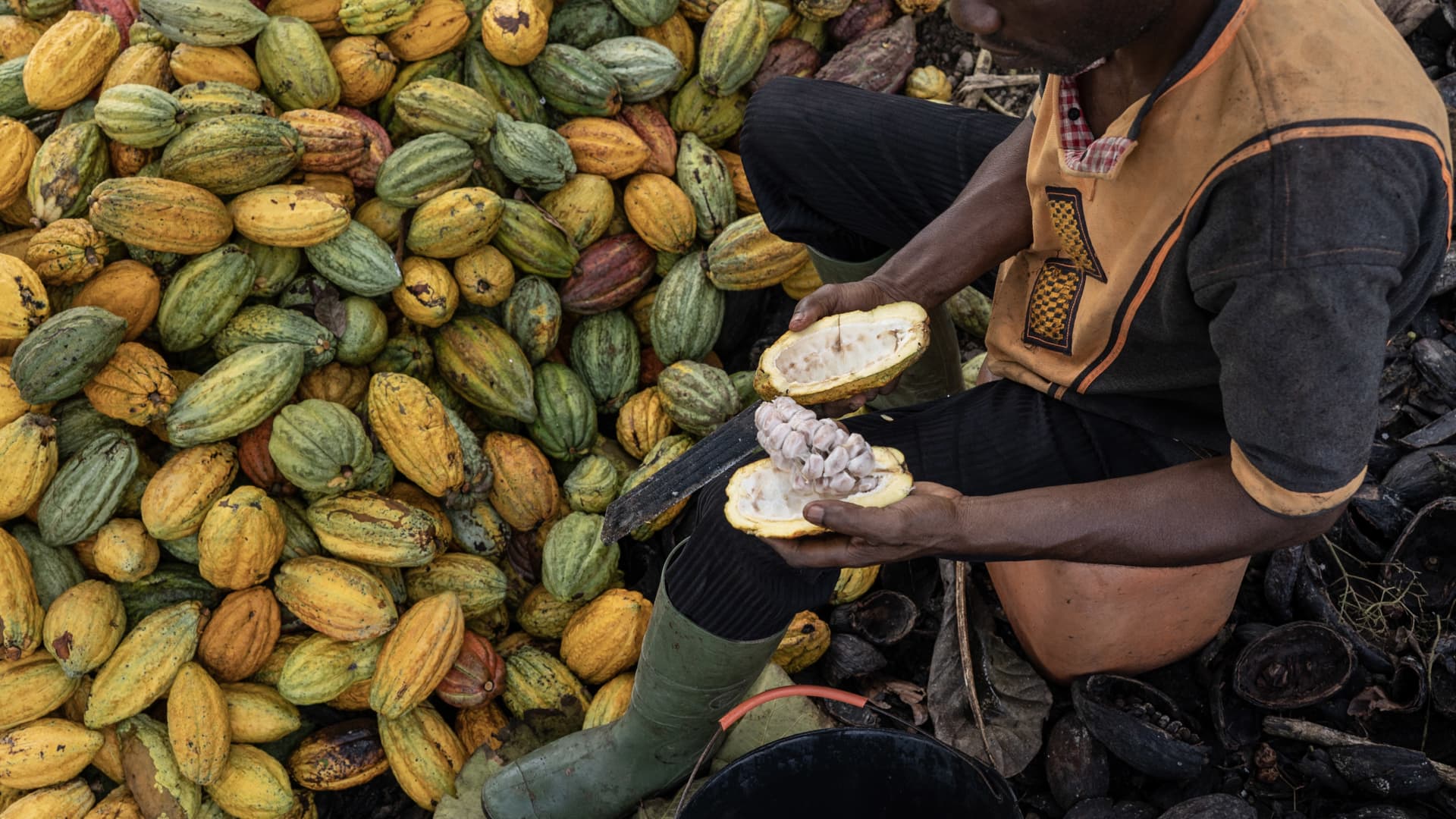
Raw sugar and cocoa prices have soared in recent months. Sugar futures reached 27.62 cents per pound last week, the highest since 2012, while cocoa futures soared to $3,763 per metric ton this month, also the highest level in more than a decade.
Prices for sugar spiked earlier this year as rising demand combined with downward crop revisions from key producing countries, such as India and Thailand, resulting from extreme weather. India, for example, is the world’s second largest sugar producer after Brazil.
“Soft commodities in particular are very fragile and very sensitive to weather change,” which can disrupt production, said Darwei Kung, head of commodities and natural resources at DWS. “That’s why we’re seeing the price go up, and there’s no short term solution because there’s only so much people can produce. And that’s not sensitive to demand as much as it is to the production side.”
Given that food and energy are not included in calculations of core inflation, Kung added that consumers may experience higher daily prices than are taken into account by central bank policymakers. That could create a “bifurcation” of perspectives around inflation that’s tougher on consumers, at least in the short-term, he said.
Shoppers are bearing the brunt of the higher prices as the world’s largest food companies try and pass along their rising input costs.
“It’s certainly not the time to talk about deflation [or] price decreases because of the significant decrease that we have seen in gross margin…We still see a high level of input cost inflation,” Nestlé’s chief financial officer François-Xavier Roger said at Barclays Consumer Staples Conference earlier this month.
The Nestlé executive noted increased costs for sugar, cocoa and Robusta beans for coffee, adding that, “obviously, some other items have declined like energy, like transportation, but net-net, still a few billions up in terms of input cost inflation in 2023.”
Unilever’s chief financial officer Grame David Pitkethly similarly noted at the Barclays conference that the company — maker of Ben & Jerry’s, Magnum and Breyers ice cream — is still seeing inflation in its nutrition and ice cream categories. In late July, Unilever reported a 12.6% rise in “underlying prices” within nutrition and 11.5% within ice cream, the latter being Unilever’s most discretionary category where “private label is attractive to the consumer,” Pitkethly said.
“We’ve got lots and lots of inflation and pricing…the consumer feels that pricing,” the CFO said.
To be sure, prices of other agricultural commodities, such as corn and wheat, have fallen from their highs earlier this year, brightening the outlook for consumers.
Benchmark soybean futures fell to a one-month low last week after the USDA reported weaker-than-expected soy export sales. Corn and wheat hit their year-to-date highs in January and February, and have fallen since.
Some analysts are counting on higher interest rates and slower economic to curb consumer appetites.
“I think that volatility persists as we understand what the harvest is, but as important as the harvest is, it’s all about understanding the demand,” said Jeff Kilburg, founder and CEO of KKM Financial.
If demand suffers, it might even foreshadow a pullback in stocks, Kilburg said.
Read the full article here