



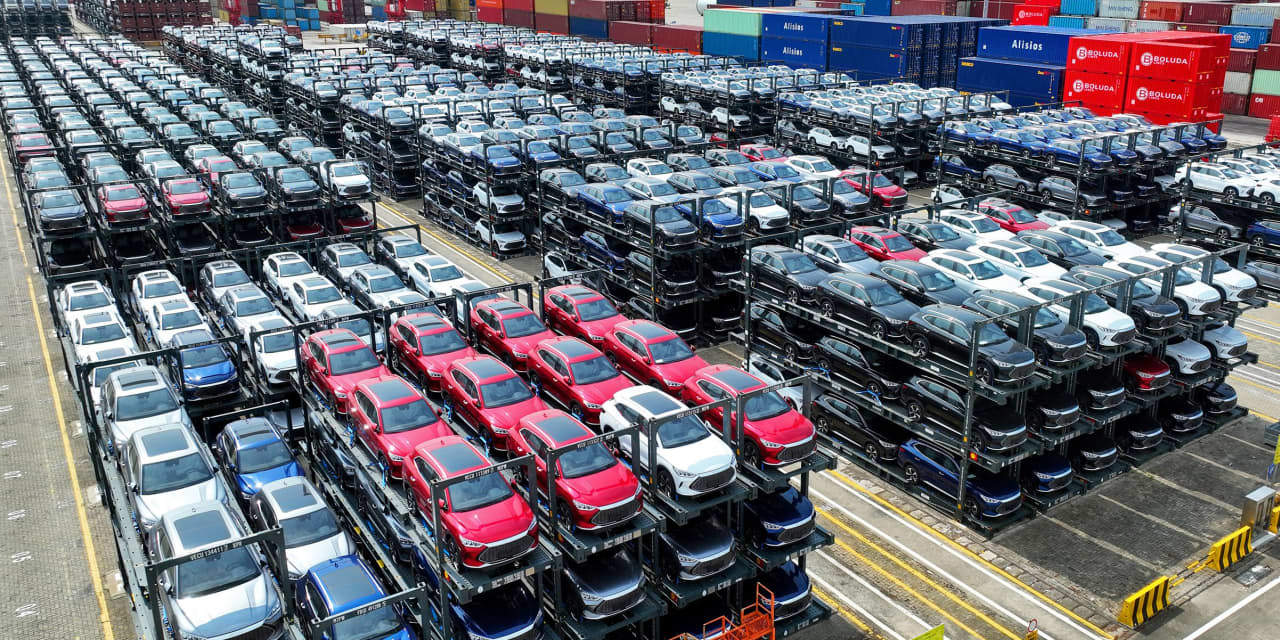
This week, the EV manufacturer reported $1.42 billion profit for the latest quarter ended in September, a 82% jump from a year ago. It’s expanding fast into overseas markets, but Stella Li, a senior vice president at the firm, told Bloomberg earlier this year that the U.S. market “isn’t under our current consideration.”
BYD
(1211:Hong Kong) isn’t alone. China makes some of the world’s cheapest EVs, but American consumers don’t have access to them—thanks to protectionist trade policies, lack of retail networks, and political rifts between the world’s two largest economies.
Chinese EVs, however, might be moving closer to the U.S. market in the coming years despite the roadblocks.
Lower Costs
Chinese EVs have huge cost advantages over their Western peers, thanks to generous government support, cheaper labor costs, and rapid technological advances. And they are getting cheaper, while the reverse is happening in Europe and the U.S.
In the first half of 2023, the average price of an EV in China was 31,165 euros ($32,920), down by 2% from last year and half the cost in 2015, according to auto consulting firm JATO Dynamics. In comparison, EVs cost €66,864 in Europe and €68,023 in the U.S., up by 20% and 7% from last year, respectively, and over 35% more expensive than in 2015.
Data from Kelly Blue Book suggest the 2023 average price for an EV in the U.S. was close to $55,000, lower than JATO’s estimates. Still, that’s much more expensive than the Chinese equivalents.
The price points are especially important for people on the fence of making the shift from gasoline and diesel cars. In the U.S. and Europe, lower-end EVs can cost 50% more than entry-level gasoline-powered cars. The cheapest EVs in China, in comparison, already cost less than its fuel-driven equivalent.
Faster Growth
That explains why the Chinese EV market is growing much faster than the West, now accounting for about two thirds of the total sales around the globe.
Last year, Chinese auto makers sold 6.8 million EVs, among which 5.3 million are battery EVs and 1.5 million are plug-in hybrid EVs, according to the Chinese Association of Automobile Manufacturers. In comparison, American consumers bought a little over 800,000 battery EVs in 2022, about 15% of China’s volume, according to Cox Automotive.
It’s not just because China has a larger population. Last year, Americans bought or leased nearly 14 million new light-duty vehicles compared with China’s 23 million passenger cars. That means one in five newly sold passenger cars in China were running on batteries, while the share was only 6% in the U.S.
BYD is the leader in China’s battery EV market, with 26% market share in the first eight months of 2023, according to the China Passenger Car Association. Rivals include GAC,
Wuling Motor Holdings
(0305: Hong Kong),
Geely Automobile Holdings
(175:Hong Kong), and
Chongqing Changan Automobile
(000625: China). Start-ups like
Nio
(NIO) and
Xpeng
(XPEV) are also taking off.
Tesla
(TSLA) is the only foreign seller making into the top 10, with a market share of 13.5%.
Europe Penetration
With the domestic market steadily growing, Chinese auto makers have been trying to expand overseas. China’s EV exports jumped from just $1.6 billion in 2020 to $20 billion last year, according to the country’s General Administration of Customs, and has already reached $25 billion so far in 2023. The majority of the exports went to Europe.
Although
Volkswagen
(VOW:Germany) is still the overall EV leader, Chinese brands are growing fast. In the first nine months of 2023, about 400,000 passenger cars made in China entered West European roads, about two thirds were from Chinese brands like MG from
SAIC Motor
(600104:China), Geely’s Polestar, and BYD, according to Schmidt Automotive research.
Chinese auto makers now account for about 3% of Western Europe’s overall car market, but 8.4% of the region’s EV market. That’s up from 6.2% last year and nearly nothing in 2019, according to Schmidt’s data.
The fast growth has already stoked fears in the European auto industry. In September, the European Commission launched an investigation into whether Beijing’s subsidies for China’s EV industry has kept prices artificially low. The Chinese government, in response, called the probe “naked protectionism”.
Roadblocks in the U.S.
Chinese EVs are quickly expanding in other overseas markets from Southeast Asia to the Mideast to Latin America. But they haven’t made any inroads in the U.S. Heavy tariffs, a lack of dealer network, and brand recognition are some of the hurdles Chinese auto makers will have to overcome.
The U.S. has used many strategies to keep Chinese EVs out. In 2018, former President Donald Trump implemented tariffs on Chinese imports worth hundreds of billions of dollars , including a 25% levy on cars made in the country. The Biden administration has kept those tariffs in place.
The Inflation Reduction Act, passed into law in 2022, offers a $7,500 rebate for EV purchases, but with strict local sourcing requirements such as where the cars are made, and where their battery components and minerals come from. In most cases, imported EVs assembled abroad aren’t eligible for the tax credits, except for when they are leased.
Chinese auto makers will also battle the many rivals already entrenched in the U.S. market, with their nationwide dealer network and decades of brand loyalty. While American consumers have been generally open toward buying foreign cars, it could be a different story with Chinese auto makers given the rising political tensions between the U.S. and Beijing in recent years.
What’s Next
Over the past few years, many Chinese auto makers have set up shop south of the U.S. border, or are looking to do so. Producing cars out of Mexico could not only help keep costs low, but also eschew the 25% tariffs imposed on cars made in China. This could set up the foundation for their expansion into the American market, if they decide to do so one day.
Some are directly coming to the U.S. through more creative ways. Last week,
Stellantis
(STLA) announced a $1.6 billion investment in Chinese EV maker
Zhejiang Leapmotor Technology
(9863.Hong Kong). The two firms will form a joint venture, owned 51% by Stellantis, for the “export and sale, as well as manufacturing, of Leapmotor products outside greater China.”
We might see more of these joint ventures in the future, says Rob Handfield, a professor of supply chain management at North Carolina State University.
Recent union victories at the Detroit Three could force American carmakers to cut back their investment in EV. Ford already said the UAW contract would add $850 to $900 per vehicle in additional costs, and that it plans to delay the $12 billion capital spending on battery plants and other EV projects.
“I think there’s definitely the potential for a joint venture to occur between a Chinese entity and one of the big three, when they realize that they’re not not going to be competitive and they may not have the funds to invest in ongoing EV innovations,” says Handfield, “Joint ventures may also allow them to find ways to get around the tariffs.”
In fact, Chinese EVs are already in the U.S. market without many realizing it. Polestar—an EV startup under Swedish brand Volvo Cars now owned by China’s Geely—is producing vehicles at its Chinese plants and exporting them to the U.S. Last year, it sold nearly 10,000 cars in America through select retail dealers.
Polestar plans to have 40 retail locations across the U.S. by the end of the year, and begin producing cars from its South Carolina factory in 2024. The Polestar 2’s price range is similar to Tesla’s Model 3—roughly between $40,000 and $60,000. The made-in-America Polestar EVs would be free from the 25% tariff, which would potentially lower the price.
Even without selling a single car, China has a tight chokehold on the U.S. EV market as it controls many critical aspects of the supply chain from battery production to raw materials. American electric car makers are reliant on Chinese suppliers in one way or another, and they might soon find themselves competing with their Chinese peers as well.
Write to Evie Liu at [email protected]
Read the full article here