


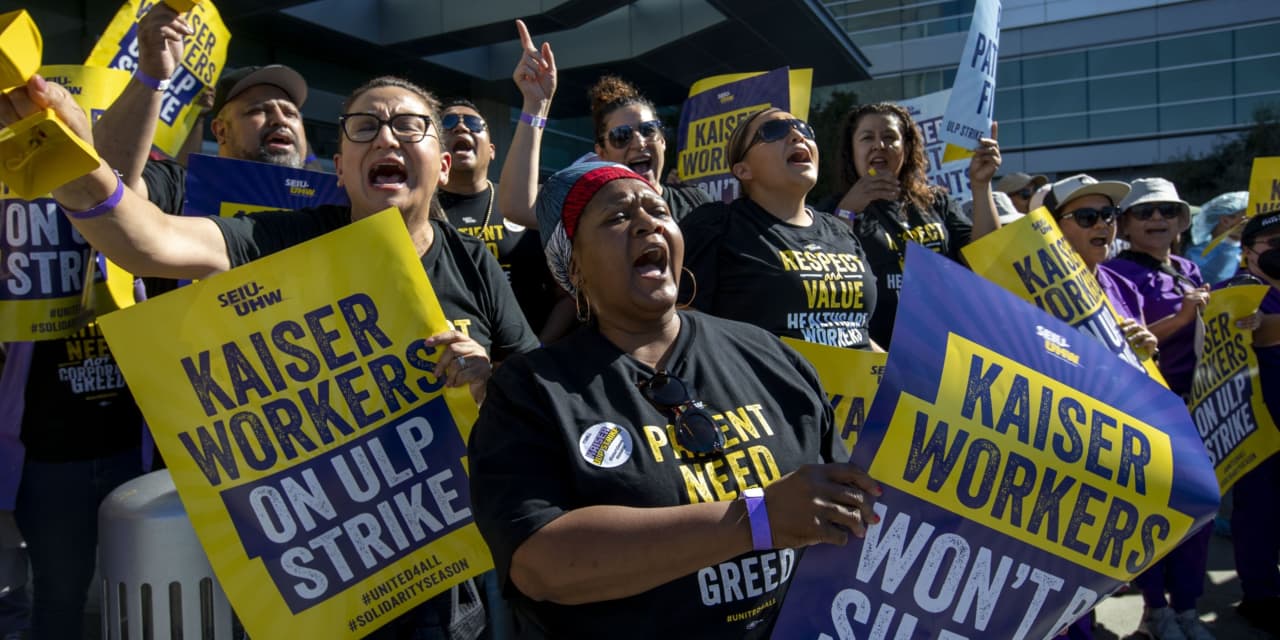
Recent labor strikes, like the action against managed-care company Kaiser Permanente, suggest workers are pushing for greater pay gains than those reported for September.
Jill Connelly/Bloomberg
After worrying most of the week about a nightmare economy of rising prices and interest rates, Wall Street wound up in a dream world of a strong jobs market with subdued wage inflation. As usual, reality lies somewhere in between.
The latest employment report, released Friday morning, shocked most everybody with a 336,000 jump in nonfarm payrolls in September, about twice the consensus of economists’ estimates, with an additional upward revision of 119,000 in the previous two months’ tally. The headline unemployment rate held steady at 3.8% as the labor-force participation rate held steady at 62.8% after an uptick in August.
This supposedly “too strong” jobs data renewed the frenzy in the bond market, briefly sending the 30-year Treasury yield back above 5%. It had briefly pierced that level midweek as well, sending stocks back into a skid.
But on further review of the jobs report, equities and debt markets recovered, allowing the
S&P 500 index
to snap its four-week losing streak. Traders apparently took notice of a subdued rise in average hourly earnings of 0.2% for the second consecutive month, a relatively modest 4.1% increase from a year ago.
The surprise September jobs report demonstrates yet again why not to make too much of any single month’s number, Vincent Reinhart, chief economist at Dreyfus and Mellon, emphasizes in an interview. Postpandemic data also have tended to be more volatile, with less reliable samples. The key takeaway is that the economy is robust, with aggregate demand expanding vigorously.
Demonstrating that trend, both the three-month and 12-month average rise in payrolls has been a robust 266,000. Strategists at BCA Research estimate it would take much smaller gains of 105,000 per month to lift the jobless rate to 4%, in line with the Federal Reserve’s median projection of 4.1% by the end of 2024.
Reinhart thinks the latest jobs numbers will let the Federal Open Market Committee lift its federal-funds target rate by another quarter point at its next policy meeting, which ends on Nov. 1. However, the fed-funds futures market puts a 73.4% probability on no change in the current target range, according to the CME FedWatch site.
What investors have to come to terms with is that the Fed is dealing with the 20th century problem of restraining aggregate demand to curb inflation, he continues. That’s a departure from the problem of most of the 21st century following the 2008-09 financial crisis of trying to support the economy with interest rates at or near the zero-percent lower bound.
This change also means the “Greenspan-Bernanke-Yellen” put has expired, Reinhart says. Which means investors shouldn’t expect the Fed to come to the rescue of stock and bond markets when they go into bear mode. That observation comes just over a quarter-century after the Fed eased policy in reaction to the market turmoil following the collapse of the hedge fund Long-Term Capital Management.
The current Fed led by Jerome Powell also might be wary of putting too much emphasis on the latest jobs report. The recent increase in strike activity suggests labor is pushing for higher pay than what was shown in benign average hourly earnings data for September, observes Cliff Noreen, head of global investment strategy at MassMutual.
Colleague Evie Liu deftly detailed the increased union activism, highlighted by the United Auto Workers actions against the three major U.S. auto makers,
General Motors
(ticker: GM),
Ford Motor
(F), and
Stellantis
(STLA). This past week, 75,000 Kaiser Permanente union workers started a three-day strike. And while screenwriters have gone back to work, actors still are on the picket lines.
Production and nonsupervisory workers have seen their hourly earnings growth slow to 4.3% relative to a year ago, down significantly from the peak 7% annual increase registered a year and a half ago, Michael Feroli, chief U.S. economist at J.P. Morgan, wrote in a client note Friday.
With the jobless rate hovering near historic lows, and the latest Job Openings and Labor Turnover report showing a 700,000 jump in openings to 9.6 million in August, and new claims for unemployment also near record lows (just 207,000 in the latest week), now would be the time for workers to press their claims for better pay.
September’s consumer price index, due out Thursday, will be the key data event this coming week. Economists expect a 0.3% increase, both with and without food and energy costs. Helpful base effects will bring the year-over-year increases down to 3.6% and 4.1%, respectively. The Fed will be watching future wage and price trends more than past ones.
Write to Randall W. Forsyth at [email protected]
Read the full article here