



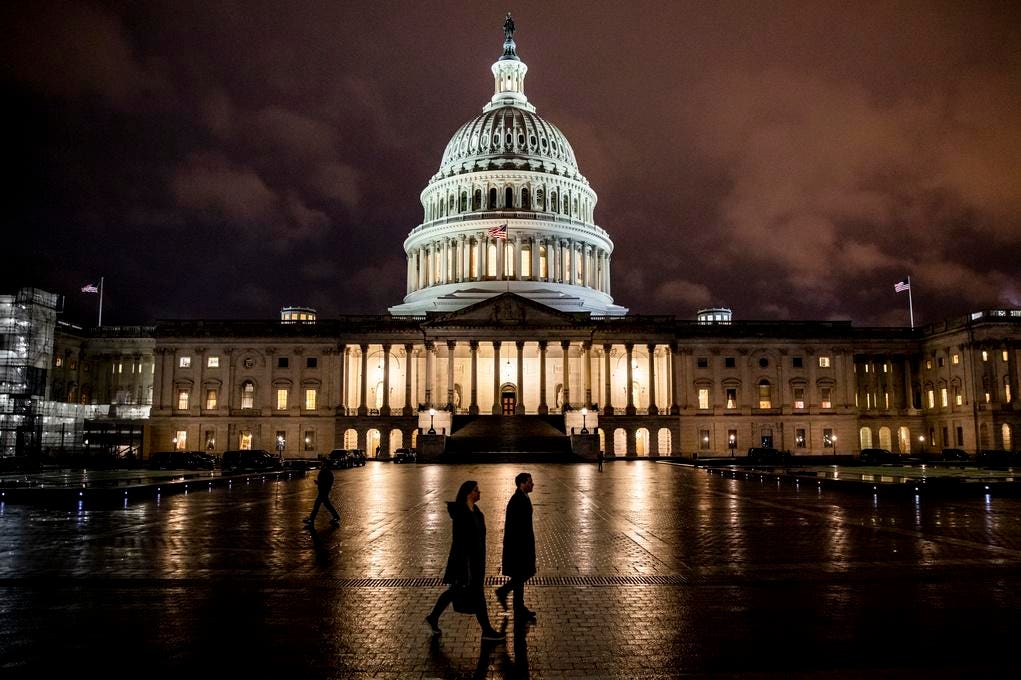
With a government shutdown potentially starting on October 1, here’s what to expect. Despite the term ‘shutdown’, many government functions will remain fully operational due to being deemed essential or having a separate budget process.
However, other government functions will shutdown or have limited operations. This means that a government shutdown will be disruptive for many, but is highly unlikely to push the economy into recession unless it lasted unusually long.
What Will Keep Operating
Many functions of government will remain operational during a shutdown. That includes Social Security and Medicare payments, these are funded through mandatory expenditure and will continue during any government shutdown.
The United States Postal Service is separately funded and will not be impacted by a shutdown. In addition, other critical functions of government will continue to operate including the military, law enforcement, air traffic control, border protection, most activities of the courts and emergency response.
What Happens To Government Employees’ Paychecks?
However, though many functions of government continue to operate, the wage payment cycle is disrupted. Federal employees will typically fall into one of three broad categories.
Furloughed
Typically hundreds of thousands of government employees are furloughed and cannot work work during the shutdown, often when their work is non-essential. In some cases they will be locked out of their work location. Their workdays will resume when any government shutdown ends, but they will be paid retroactively for the shutdown period as guaranteed by a law passed in 2019 (this was common practice before 2019, but the law made it official). For example, this may be the case for NASA or Security and Exchange Commission employees not working on critical functions. This is obviously a real cost of a shutdown to the government as employees cannot perform work, but are still ultimately retroactively paid regardless. In addition, delayed paychecks can stress hundreds of thousands of household budgets.
Excepted
Other employees may be “excepted” these are employees performing critical functions as defined by the Department of Justice and the Office of Management and Budget. This group is required to work but will not be paid during the shutdown period. Just as with the furloughed group, retroactive pay will occur when the shutdown ends.
For example, this group may include air traffic controllers, where danger to life and property would be substantial if they did not work. Here there is economic disruption, as working without a immediate paycheck may stretch most household budgets, even if pay will come retroactively when the shutdown ends. There is also some risk that employees though required to work without immediate pay, do not chose to do so and simply find another job, disrupting services such as airport security screening as has occurred during past shutdowns.
Exempted
A third group of employees are exempted. These employees typically work for parts of the government funded outside of the annual appropriations process and so their work can continue without immediate disruption. This may be the case for employees of the United States Postal Service, given the different funding mechanism used. As these budgets are not impacted by the shutdown, regular pay will continue for these employees. This group is less impacted by a shutdown.
What Will Shut down
What remains operational and what shuts down among the functions of government paid for by the annual appropriations process, is, in many cases, the decision of the Department of Justice and the Office of Management and Budget. However, based on prior shutdowns, it is likely that most non-essential functions of government will be disrupted. Processing of tax returns by the Inland Revenue Service will likely stop as will inspections by the Environmental Protection Agency. It’s also likely that National Park and Museums as well as certain Immigration Services, the Security and Exchange Commission and NASA will see limited services.
Processing of many loans and grants are likely to be delayed, this includes health research grants, Housing and Urban Development assistance and Small Business Administration loans. In most cases, work here will be delayed and resume when the shutdown ends.
Government research such as economic research and weather-related research will likely stop except for essential services such as severe storm warnings. Ironically, this can make the economic impact of a shutdown harder to gauge, if it persists and economic data is not delayed.
The Overall Impact
The biggest economic impact of the shutdown is simply the delay in payment of wages to many federal employees. Yes, legislation from 2019 guarantees retroactive payment when the shutdown ends, but the delay in wage payments, depending on the length of the shutdown, could be disruptive to household budgets.
Also, government contractors face a more ambiguous situation. They may or may not be required to work but back pay is not always guaranteed, or if they are paid, then there employer may not always be reimbursed by the government.
Then many functions of government do continue, either due to being deemed essential or because they are not directly funded by the annual appropriations process. However, the disruption from delayed permitting, grants, inspections and processing in many non-essential parts of government can add up depending on a shutdown’s duration.
In part, the potential pain associated with a longer shutdown helps explain why government shutdowns have historically been brief, some have even lasted just a few hours while politicians hammer out a deal.
A shutdown of a few days, as has historically been the case, has a much lesser impact than one that last two weeks or more, which is historically far less common. So the risk of the economic severity of a government shutdown is likely related to how long it lasts, and most have been short.
Read the full article here