



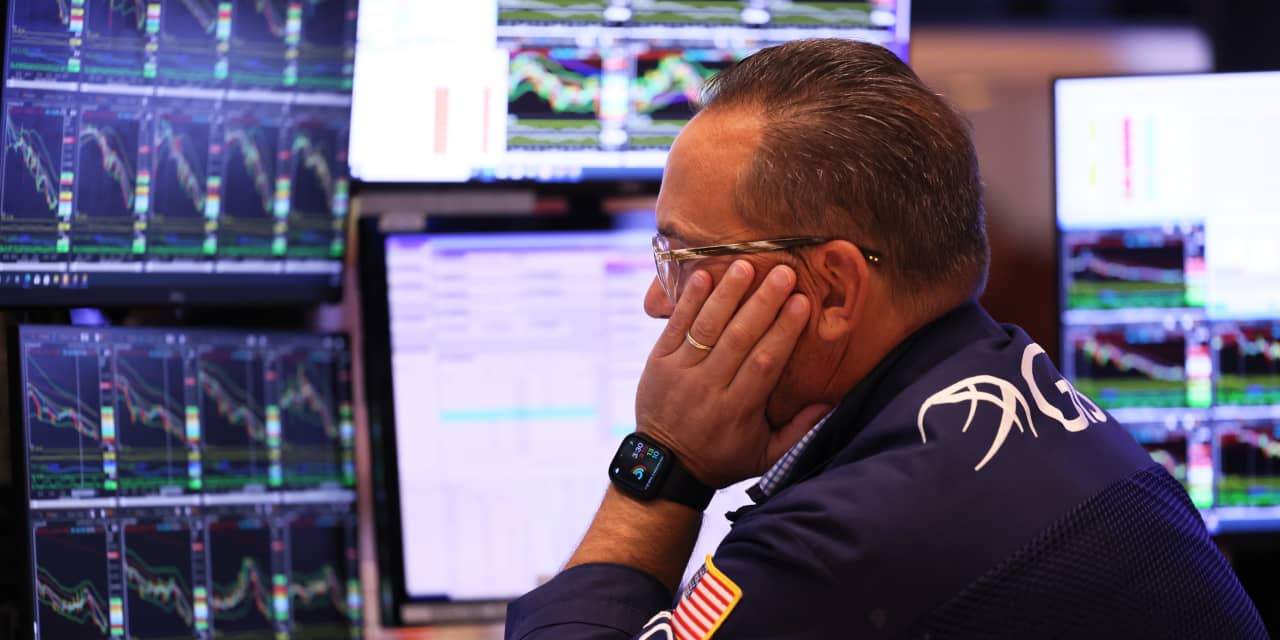
Low-volatility funds won’t necessarily perform better in down markets.
Michael M. Santiago/Getty Images
When volatility grips the market, as it has in recent weeks, investors may be tempted to turn to strategies that promise a smoother ride, such as low-volatility stock funds. But it’s important to look under the hood, experts say, as portfolio construction—and performance—can vary widely.
The idea behind low-volatility funds is simple: stocks that fluctuate less than the market as a whole are supposed to do better in bad times while still faring well in good times.
“These funds are trying to give investors a stock portfolio that offers lower volatility and better downside protection than your run-of-the-mill stock portfolios,” said Ryan Jackson, manager research analyst for passive strategies at
Morningstar
Research Services. “This is for investors who don’t totally want to take their stock exposure off the table, but maybe feel a little bit uneasy about what lies ahead.”
The fact that they’re supposed to reduce volatility doesn’t mean they’re immune to drawdowns.
In 2020, for example, several funds lost at least as much as the market in February and March, but later lagged behind when stocks shot up.
Matthew Bartolini, managing director at State Street Global Advisors and head of SPDR Americas Research, cautioned investors not to try to time the market and to look closely at portfolio construction.
“The construction philosophy can really have a significant impact when thinking about factor investing as there can be some [sector] biases,” he said “that is why due diligence is really important. Know what you own is a very simple philosophy, but it really applies here.”
Morningstar’s Jackson said there are two main schools of thought for constructing portfolios, exemplified by the two largest low-volatility ETFs: the $26.5 billion
iShares MSCI USA Min Vol
Factor ETF (ticker: USMV) and the $7.8 billion
Invesco S&P 500 Low Volatility ETF
(SPLV).
The iShares ETF starts with the MSCI USA index and selects stocks not only based on volatility, but also their correlation to other stocks. About 24% of the ETF is in information technology, with its top three holdings
Eli Lilly
(LLY),
International Business Machines
(IBM), and
Cisco Systems
(CSCO).
The Invesco ETF tracks the 100 stocks in the S&P 500 with the lowest volatility irrespective of their sector. Its top three holdings are
Coca-Cola
(KO); McDonald’s (MCD), and Waste Management (WM).
This is a more straightforward approach, said Todd Rosenbluth, head of research at VettaFi, a financial research and data company, but from a sector perspective, the portfolio leans toward defensive sectors, such as consumer staples, utilities, and healthcare, at the expense of the more cyclical sectors, such as information technology, communications services, and energy.
“These are two different ways of attempting to get the same lower-risk tilt to a portfolio,” he said. “They don’t perform exactly the same because of the difference in what they own.”
The two funds have delivered starkly different performance this year: the iShares ETF, which has a dividend yield of 1.86%, is up 0.81%, trailing the broader stock market, which is up about 9%. The Invesco fund, with a dividend yield of 2.4%, is down 6.76%.
As to whether these strategies are delivering on what they purport to, Jackson said, “for the most part, yes.”
Looking at the performance of both funds over the past 10 years, through September 2023, Jackson said, “SPLV only captured about 67% of S&P 500 downside, so it’s generally showing a lot lower volatility, tis average drawdowns are a lot shallower and overall isn’t quite having those same swings as its parent index the S&P 500.” He added the same goes for the iShares ETF, “less volatile, shallower drawdowns, and only a 71% downside capture ratio against its parent index the MSCI USA.”
At the end of the day, these are stock portfolios. “They likely won’t work in 100% of drawdowns,” Jackson said. “But held over the long term, you can expect to see them do a better job of protecting the downside.”
Write to Lauren Foster at [email protected]
Read the full article here