



Economic policy uncertainty has surged since Donald Trump’s election. This could be bad, not just for the stock market, but also for business investments and for consumer spending. The economy could slow just because the direction of economic policy is unclear.
Policy uncertainty has surged in recent months. At this point, it is unclear whether tariffs will happen, whether the federal government will stay open after March 14, whether the federal government can deliver basic services such as processing Social Security applications, after the Trump administration has laid off large shares of workers and whether slowing immigration and increasing deportations will translate into higher inflation. This level of uncertainty associated with economic policies alone could result in bad economic outcomes for solid economic reasons.
Researchers from Stanford, Chicago and Northwestern University have compiled Economic Policy Uncertainty indexes for a number of countries, including the United States, going back decades. This index for the U.S. combines information from newspaper articles that relate to economic policy uncertainty, details on tax provisions that expire within the next decade and differences in forecasts about prices and government spending.
Economic Policy Uncertainty Jumped After the Presidential Election
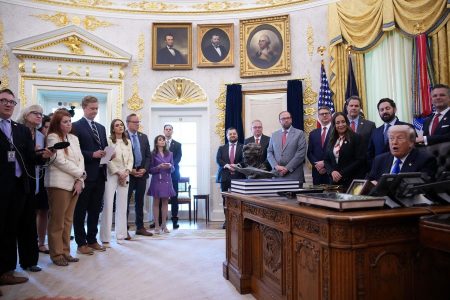
The index then reflects economic policy uncertainty emanating from a wide range of sources, whereby higher values of the index mean more uncertainty. The index for the U.S. has jumped from 97.3 in October 2024 to 161.70 in January 2025 – a jump of 66.2% – largely because of increased uncertainty reported in newspapers. This presumably reflects the uncertainty over what Donald Trump will or will not do as president. Importantly, this jump in the index happened before he took office and his administration took a sledgehammer to government functions and policies with an unclear path forward for government services, spending and taxes.
Uncertainty Rises and Falls with Presidential Terms
A quick summary of the policy uncertainty index shows a few key things. Uncertainty increased especially under President George W. Bush (up by 54.3%) and President Trump’s first term (up 54.2%), while it fell under President Obama (down 21.6%) and President Biden (down 22.2%). It was more or less flat during President George H.W. Bush (up 1.7%) and President Clinton (up 4.3%). Presidential terms and possibly party affiliations correlate with economic policy uncertainty, while overall economic policy uncertainty has become a lot more volatile and widespread over time, especially since the early 2000s. The onset of the new Trump administration will possibly exacerbate historical patterns with even more volatility in economic policy uncertainty.
The composite index data for the U.S. go back to 1985 on a monthly basis. Those are enough observations to correlate information about policy uncertainty with data that are relevant to businesses and consumers. In particular, the industrial production index from the Federal Reserve shows key movements in business activity. The University of Michigan’s Consumer Sentiment Index, especially the Index of Consumer Expectations, reflects forward looking evaluations of prices and economic conditions. When consumers have more positive outlooks for the future, they are more likely to buy big ticket items like cars and houses. Those purchases will translate into stronger and more stable economic growth. Industrial production and consumer sentiment are then good monthly indicators of where the economy may be heading during a period of heightened policy uncertainty.
Industrial Production and Consumer Sentiment Worsen With Increasing Uncertainty
A simple question is whether periods of above long-term average growth in policy uncertainty correlate with lower growth in industrial production and consumer sentiment about the future than is the case during periods of below the long-term average growth of uncertainty. Since the pandemic was a period of extreme policy uncertainty, it makes sense to calculate the long-term average growth of the economic policy uncertainty index from 1985 to February 2020 as a threshold for above-average or below-average growth. The average annual growth of the Economic Policy Uncertainty index was 0.4% over this period – the long-term average growth rate.
So, what happens to changes in industrial production and consumer sentiment about the future when economic policy uncertainty grows faster or slower than this historical average? Industrial production on average grew by 0.9% year-over-year when economic policy uncertainty had above average increases and by 2.5% when economic policy uncertainty grew below average during the same time. The median growth rate was 2.0% for periods with above average uncertainty growth and 2.8% for periods with below-average growth. Consumer sentiment about the future fell by 4.4% during periods of above average increases in policy uncertainty and grew at an average rate of 4.5% during periods of below average gains in economic policy uncertainty. At the median, the consumer sentiment index fell by 3.3% during periods of above average increases of uncertainty and increased by 3.3% when uncertainty grew below its long-term average.
The data show a clear divide in industrial production and consumer sentiment associated with economic policy uncertainty. More uncertainty correlates with slower industrial production growth and more pessimistic consumer outlooks on the future. Economic policy uncertainty has risen since the presidential election, in large part because President Trump has wreaked chaos in Washington, DC, even before taking the oath of office. A less predictable economic policy environment makes it harder for businesses and consumers to plan, potentially contributing to slowing economic activity in 2025.
Read the full article here