



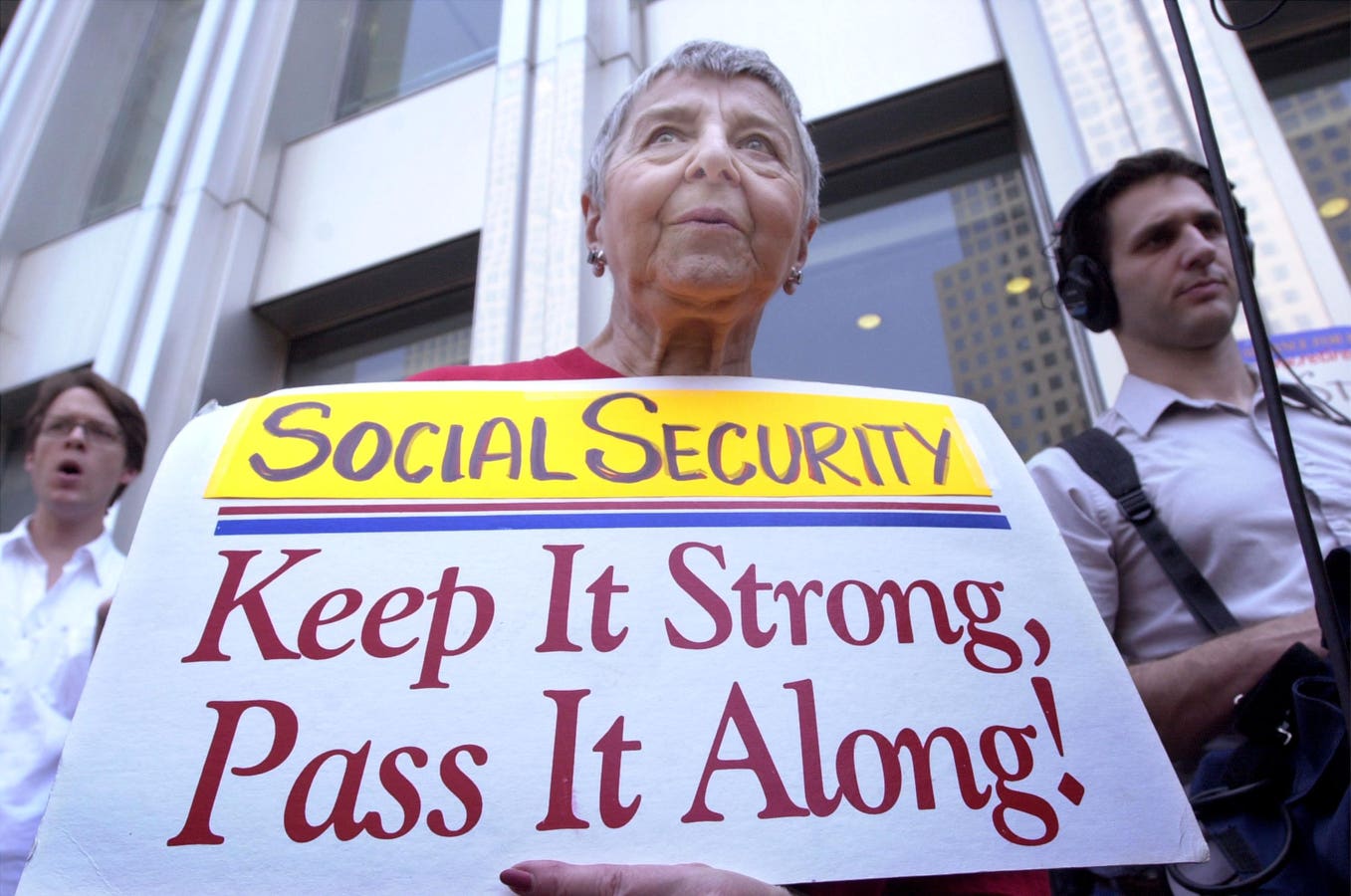
The U.S. government shutdown has begun to affect an area many Americans take for granted: Social Security benefits. Yesterday, the government failed to release a critical report—the Consumer Price Index (CPI)—which determines the final cost-of-living adjustment (COLA) for Social Security in 2026. With a reduced Social Security workforce, approximately 75 million retirees, disabled beneficiaries, and survivors now face increased uncertainty about next year’s COLA.
Each October, the Bureau of Labor Statistics (BLS) publishes the September CPI for Urban Wage Earners and Clerical Workers (CPI-W), and the Social Security Administration (SSA) uses that as a required ingredient in its annual COLA calculation. But this year, the shutdown has stalled BLS operations, blocking the release of that data (originally due Oct. 15). As a result, SSA has postponed its COLA announcement from its usual mid-October date to October 24.
Why The CPI Delay Matters For The COLA Process
The COLA formula is straightforward but its execution requires timely data and an experienced and adequately resourced workforce in the Social Security Administration. the formula compares the average CPI-W over the third quarter (July–September) of the current year with the same quarter of the prior year. If inflation has risen, benefits are increased accordingly effective December (payable January). Without the CPI release, SSA cannot finalize the adjustment. The shutdown-induced disruption makes that precise timing difficult for an already stressed agency.
Estimators such as The Senior Citizens League had predicted a COLA of 2.5 %, with some forecasts rising to 2.6% or even 2.7%, due to inflation pressures driven by services and tariffs. However, the official number remains uncertain until the Bureau of Labor Statistics (BLS) publishes the final data.
The Operational Headache To Implement The COLA With A Shrunken Staff
The Social Security Administration has been shaken since Donald Trump became President and Elon Musk’s DOGE cut the agency and closed regional offices. To meet a revised Oct. 24 COLA timetable, the government plans to bring back some furloughed BLS employees – not to restore full agency operations, but only to release the CPI data used in the COLA formula. But that reinstatement is narrowly focused and does not extend to releasing other vital government statistics like the monthly unemployment report. I am concerned, along with other experts, that the combination of late data and agency erosion will result in a partial reboot of the statistical and operational machinery to get checks out on time.
The Social Security Administration must marshal the remaining personnel to validate the data and compute COLA increases, reprogram payment systems, and ensure administrative readiness for over 70 million benefit checks to be sent starting in January. The agency will have to decide which staff can be recalled, which workflows should be prioritized, whether to reassign or accelerate processes, and how to cross-train remaining staff to cover gaps in tasks and roles.
But since the SSA’s workforce has been slashed, the COLA computing process – that used to be routine – will be shaky. In February 2025, the DOGE plan called for 12% cut in Social Security’s workforce (about 7,000 positions). Between March 2024 and March 2025, 46 states saw net field-office staffing declines; 30% of offices lost over 10% of personnel. SSA’s internal reporting confirms that attrition plus under-hiring drove headcount down in FY 2024.
In short, the SSA is being asked to deploy a lean skeleton crew to produce highly sensitive financial indexing under a tight deadline—at a time when staffing levels are already below expected levels. The potential impact on confidence, error risk, and backlogs could be substantial and negative.
The Implications Of The Shutdown on Americans’ Trust In Social Security
When the machinery of Social Security is visibly strained, the public’s confidence erodes. Beneficiaries depend on annual cost-of-living protections to maintain their standard of living. If those protections falter, older Americans may begin to question whether the system is still reliable.
Consider the bare facts: 74.5 million people are receiving Social Security and SSI benefits as of August 2025. They are waiting for the COLA announcement whose timing and accuracy now depend on contingency moves under duress. It is not farfetched to imagine anxiety about whether they will receive benefits on time.
And provoking anxiety among this population is unnecessarily cruel. Many beneficiaries have no alternative to Social Security: for millions, COLA-adjusted Social Security is their lifeline, not a supplement.
Why the COLA Matters
Absent any COLA, a beneficiary who began with a $2,000 per month benefit 15 years ago would still get $2,000 today. Inflation would have eroded her purchasing power by 48%. If we assume a moderate average COLA of 2.6 % annually, that $2,000 would now be roughly $2,964 – a 48 % gain – just to preserve her standard of living.
That difference is thousands of dollars over time and is the difference between ending one’s years in (relative) financial stability or being pushed closer to poverty.
Because the COLA is based on exactly three months of data—and this year, two of them have already reflected inflationary pressures—most expect the 2026 COLA floor to land around 2.6% to 2.7%. Tariff-induced inflation and rising service prices reinforce that expectation. That said, the delay caused by the shutdown undermines the public’s ability to plan.
Conclusion: The Shutdown Stresses Social Security
The 2025 government shutdown has triggered widespread consequences, including delays in the release of key statistical data. But for retirees, disabled Americans, and survivors, the impact is more than technical—it’s deeply destabilizing. The COLA represents a contract between a generation and its government. When that contract is disrupted by missed deadlines or procedural failures, the broader social compact begins to fray.
The current President and Congress have shaken public confidence in Social Security. Now, the nation waits to see whether a weakened agency, working with delayed data, can still deliver a fair COLA—and communicate the changes clearly—under mounting pressure.
Read the full article here